



Most Hard Conversations Go Wrong in the First Sentence
Issue #33
By Debbie Lawrence
Read time: 9 minutes
Renee could not get out of the gate.
She was a student in one of my leadership programs, where I teach how to have hard conversations. She shared that before the training she knew who she needed to talk to and why. Her trouble started the moment she opened her mouth.
Her opening sounded something like this:
“You were late again, and your update was the first agenda item. Plus the way you sauntered into that meeting made it obvious to everyone you don’t take this part of your role seriously at all.”
The other person got triggered, and from there the conversation was about what Renee thought and felt. What had actually happened got lost.
It kept happening, and she couldn’t see why. Then we got to this part of my program, and she finally saw what had been tripping her up.
What Renee didn’t know before was that the conversation was going sideways before it had really started. She was mixing the facts with her opinions, thoughts, and feelings, all in the same breath.
Why the first sentence matters
When people get triggered, their ability to think logically and analytically shrinks. The more triggered they are, the less of it they have in that moment.
So their attention goes to the opinion you just shared, and the facts slide out of the room. Now you’re debating whether they sauntered or walked or rushed into the room, and their responsibility for being in the meeting on time and contributing in a meaningful way has disappeared. It’s a slippery slope, and you’re on it within seconds.
Knowing how to open a hard conversation is golden. And it’s a skill you can build.
But there’s a step that comes even before the opening, and that’s recognizing you need to have the conversation at all.

Your body usually knows first
Someone does something that isn’t helpful. It could be a client, a team member, a fellow manager, or the person you report to. Sometimes you want them to stop outright. Sometimes you want them to do it slightly differently, and sometimes completely differently.
Then the voice in your head starts up. I can’t believe they did that. Isn’t that common sense?
You get activated, to one degree or another as your frustration or annoyance seeps out. That’s natural, and it’s also your signal that a line has been crossed. A boundary has two sides, what’s okay and what’s not okay, and someone just stepped over it.
This is one more place where your nervous system regulation work pays off. The less activated you get, the easier it is to stay curious and hold off on judging, jumping to a conclusion, and reacting to it.
Where good leaders get stuck
Noticing the line was crossed is one thing. How a leader responds is another, and there are a few themes that come up when I coach leaders preparing for a hard conversation:
“Isn’t that common sense?” It only means it’s common sense for you. We’re measuring the other person by our own yardstick, when we have to measure them by theirs. The way you discover their yardstick is to get curious and go talk to them.
“I’ll give it a few days.” Take some time, because that’s how you avoid saying something you wish you hadn’t. Use it to think about your approach. But if you wait three days, their memory starts to fade, the details get vague, and they don’t recall it the way you’re describing it. The closer to the incident, the better for you, and absolutely the better for them. My guideline is to have the conversation that day if at all possible.
“They’ll know what I mean.” So we sugarcoat it, dance around it, and hope they can read between the lines. When there’s a gap, their brain makes up a story to fill it. I think this is probably what she means. Then they move forward on their interpretation, and you wonder why nothing changed. That’s why I keep saying clarity is kindness.
“I don’t want to sound blunt.” Good news: you don’t have to be. I’ll come back to that one.
The generous assumption
The first time someone crosses a line, the person is what I call a boundary crosser. That’s all that has happened. They crossed a boundary.
So I offer them a generous assumption. I give them the benefit of the doubt: if they knew differently, they would do differently.
In my coaching and teaching, we use the language Model A and Model B for hard conversations. Think of them as two very different templates, each with its own structure and a slightly different approach. You don’t want to use B when you need A, or A when you need B.
Model A is the one you’ll use most often. You pick a private time and place that feels safe, you come at it with respect for them as a coworker, and you give them the feedback as close to the incident as you can.
And before you walk in, there’s one exercise I give every leader I teach.
Separate the facts before you walk in
I didn’t always know how to open these conversations. Early on, I had conversations where my feedback landed flat, or was so vague the person left more confused than when they came in, or was so blunt it couldn’t be heard. I learned this through trial and error.
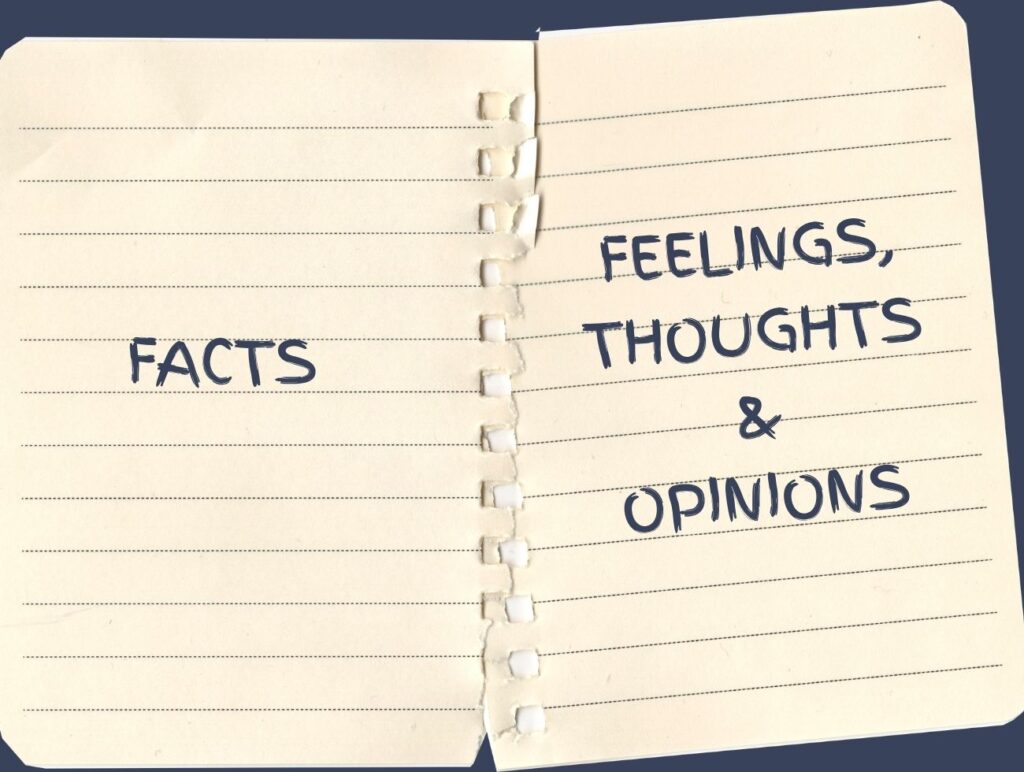
Capture everything about the situation on paper. Then look at it and separate the facts of what exactly happened from any thoughts, feelings, or opinions you have about those facts.
Facts are neutral by nature. They’re neither good nor bad. They just are. Today is Wednesday. If you asked 50 people today, all 50 should say yes, today is Wednesday.
With a thought, a feeling, or an opinion (and it’s going to be about one of the facts), it’s statistically unlikely that everyone will agree with you. Any time there could be a difference of opinion, you know you’re in the land of thoughts, opinions, and feelings.
Here’s what that sorting looks like with Renee’s opening:
Facts: You joined Tuesday’s team meeting 15 minutes after it started. Your update was the first agenda item.
Opinions: You sauntered in. It was obvious to everyone. You don’t take this part of your role seriously.
The facts go in your opening. The opinions stay on your paper for now.
“I noticed you joined Tuesday’s team meeting 15 minutes after it started. Your update was the first agenda item. Help me understand what happened.”
When you stay factual and share what you observed, you’re less likely to heighten the activation of the other person’s nervous system. They can still think, which means you can still have the conversation.
This is what turned things around for Renee. She shared that she now takes the time to separate the facts from her thoughts, opinions, and feelings, and she focuses only on the facts in the opening of her conversations.
She hasn’t had a single hard conversation go off the rails at the very beginning.
Blunt, clear, and vague
You’ve read this issue after issue: you have permission to be direct, clear, respectful, and thoughtful. People often confuse being direct with being blunt, and they’re two completely different things.
Take that same team meeting.
Vague is sugarcoating and hoping they catch on: “Just a reminder for everyone to try to be on time when you can.”
Blunt is direct, unfiltered language with little or no consideration for how it’s going to land: “You were late again. Colleagues notice. Fix it.”
Clear says exactly what happened and what you expect, and considers how it will land: “You joined Tuesday’s team meeting 15 minutes after it started. Your update was the first agenda item, so the rest of the agenda was pushed back. From now on, I need you in every team meeting by the start time. What might get in the way of that?”
Leaders consistently tell me they thought being vague was the kind option. It’s the most unkind of the three. If people don’t understand what has happened, how can they possibly course-correct? They just can’t.
Clear leaves no gray area and no wiggle room, and that increases the likelihood you’ll get the outcome you’re looking for. Your team member also walks away knowing exactly what they’re supposed to do. That knowing brings them comfort and helps to keep their nervous system regulated the next time they go to do the thing.
Whether you like it or not, this is part of what you agreed to when you became a leader: giving timely, thoughtful, respectful, direct, and clear feedback to the people who work for you.
Get comfortable feeling uncomfortable
Early in my career, I thought I needed to get good at hard conversations so they’d get more comfortable. What I learned is that there’s a gift in the discomfort, and that you never want to be 100% comfortable.
The mantra I use in my teaching and coaching is this: you’ve got to get comfortable feeling uncomfortable.
I always tell people to be wary of anyone who says they have no problem having a hard conversation, that it’s easy for them. To me, that signals a very good chance they’re walking in without the caution, respect, and care that any conversation like this needs.
I have no research to back this up, but I’m going to guess that the person who says, “Oh, this is easy for me,” is also the person who walks in blunt and does damage to the relationship.
The person who feels a certain degree of discomfort is more likely to be clear. That discomfort is healthy. It tells you you’re in the right mindset and you’re being careful and respectful with this conversation.

When once isn’t enough
Sometimes you have to go back. The person says, “Thank you for that feedback, I’ll work on it.” They correct 60% of it, and 40% is still there. That’s not unusual. You have a second conversation, circle back, and remind them of the 40%.
I’ve taught this, coached people through it, and done it myself for decades, and what I know is that you should see forward movement within two conversations.
Sometimes you don’t. They’ve changed nothing, or almost nothing, and there could be 50 different reasons why.
Technically, someone becomes a boundary violator the second time they crossed the same boundary, because you’ve already spoken to them. I still give them a generous assumption that second time around. By the third time, you know you’ve got a boundary violator on your hands. They know the difference, and they keep doing the thing. That requires a different approach, and it’s something I work through with leaders in my coaching.
If you’re heading into a third conversation, you can repeat Model A, or you can shift up to Model B. That’s the conversation for when things have become more serious. There are now consequences, and those consequences have to be identified.
You’ll feel the shift in your body too. You’re frustrated and annoyed. Keep that frustration on the behaviour, and keep the conversation on the issue.
All of it starts in the same place: something happens, a boundary is crossed, and you recognize you need to address it as soon as you can.
Your turn
Think about the last time someone’s behaviour triggered your autonomic nervous system and made you think, Isn’t that common sense?
This week, write down everything about what happened and separate the facts from your thoughts, feelings, and opinions. Then write your first sentence using only the facts.
You’re allowed to be both kind and clear, and it starts with that sentence.
Comment below and tell me: what’s the conversation you’ve been putting off, and what’s your first sentence?
I read and reply to every response. And I love hearing about what you’re discovering.

P.S. You can also listen to this issue on The Compassionate Leader School podcast episode, which drops the same day on Apple Podcasts, Spotify, and all major platforms. Click here to explore all the episodes.
