

You’re Burnt Out Because You’re Playing By Rules That Were Designed to Exhaust You
Issue 01
By Debbie Lawrence
Read Time: 6 minutes
A while back I had a conversation with my client Lisa. She’s a senior leader in a successful events planning company who leads a team of thirty and has been in this role for ten years. She’s good at what she does—so good that her clients rave and revenue grows year over year.
But she’s exhausted.
Recently, her executive chef Marcus made a unilateral decision to change a menu for a wedding when a major vendor fell through. It was a $50,000 client and he did so without consulting her. Plus, he only told the client after the decision was made, asking the client to trust his judgment. Fortunately, the client agreed; and Marcus’s confidence and decisiveness in that moment was heralded as having “saved the day”.
Lisa should have been relieved. Instead, she felt… something else.
Because two weeks prior to that, she’d made a similar decision by changing a venue for a corporate client based on her expertise. The original venue had been sold and the new owners were making arbitrary changes to the rules of engagement. Lisa consulted the client about moving the event to a different venue. The client was unsure but Lisa knew that staying at this original location was riskier than making a move so she appealed to the client and asked them to trust her. They did but they also complained to Lisa’s boss about how she was “aggressive” and “not collaborative enough.”
When she learned about this feedback she apologized profusely. Lisa adjusted, made herself smaller, and questioned her judgment for days.
Marcus’s identical behaviour was praised as “leadership.”
Hers was criticized as “aggressive.”
She sat in her office after everyone left and tried to make sense of it. She’d been trained her whole life on the rules:
- Be confident, but not too confident
- Be direct, but not harsh
- Lead, but don’t make anyone uncomfortable
- Be successful, but don’t make others feel bad about it
- Speak up, but not too much
- Take charge, but stay likable
She’d followed every rule carefully, even to the point of exhaustion.
And somehow, it was never enough. She was always too much or not quite there. Never just right.
Marcus didn’t seem to have to follow any of these rules. He didn’t even seem to be aware such rules existed. He was direct and confident. He was unapologetic and everyone respected him for it.
What would happen if she led like that?
The thought terrified her because some voice inside that had been trained over decades whispered: If you lead like that, they’ll think you’re difficult. Demanding. Too much.
And then what?
Lisa didn’t know. She’d never tested it. She’d been too busy following rules designed to keep her playing small.
The playbook nobody handed you (but you learned anyway)
What Lisa didn’t know yet was that the playbook she was following was never designed to help her succeed. It was designed to keep her manageable.
No one sat her down and gave her a rulebook titled “How to Stay Small” but she learned it anyway. Through every interaction, every correction, every time she was rewarded for shrinking and punished for expanding.
She learned by watching what happened to women who followed the rules (they were liked, accepted, kept safe) and women who broke them (they were criticized, isolated, called names).
The rules felt like truth because she’d been following them her entire life. But they weren’t truth. They were instructions for staying manageable.
And breaking them wasn’t rebellion. It was the authentic way to lead.

The three rules keeping you exhausted
I see Lisa’s exhaustion in almost every woman leader I work with. They’re all following the same rules without realizing it and it shows in their behaviour.
Here’s how to spot them:
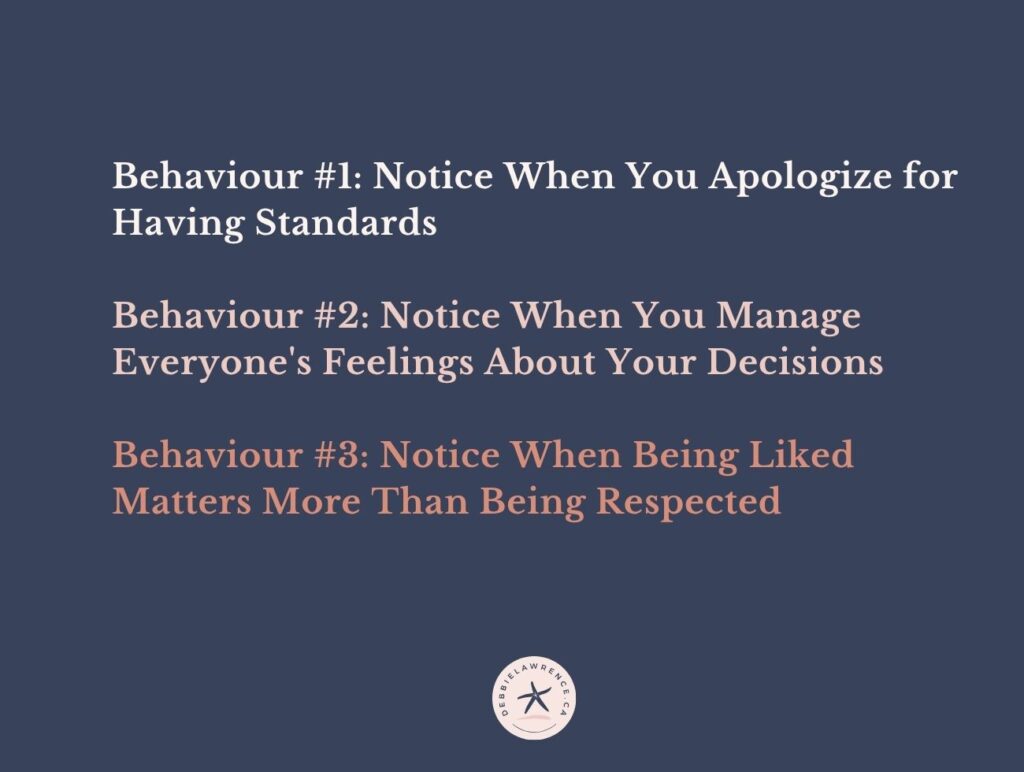
Behaviour #1: You apologize for having standards
Listen to yourself over the next week. Count how many times you soften your expectations with phrases like “if you get a chance…” or “no pressure, but…” or “sorry to bother you, but could you maybe…”
Here’s what this looks like in real time: You need a proposal revised because it has the wrong client name in it and three data points are incorrect. Instead of saying “This needs to be corrected before it goes to the client so please resubmit the updated version by 3pm,” you write: “Hey! So sorry to bug you, but I noticed a few tiny things that might need tweaking if you have time. No rush! Just whenever you get a chance. Thanks so much!”
You just apologized for asking someone to do their job correctly.
Your male peer? He writes: “This needs to be revised. The wrong client name is used throughout. Plus, there are three incorrect data points. Have the fix in my inbox by 3pm.”
Nobody calls him mean. They call him decisive and a “take charge” kind of leader.
This is the clearest signal you’re following a rule that doesn’t apply to your male peers.
Behaviour #2: You manage everyone’s feelings about your decisions
Leaders make decisions. You, however, make decisions AND try to manage how everyone feels about them.
This one trips up so many women who lead because they confuse leadership with being everyone’s emotional support system. They think “bringing people along” means making sure nobody ever feels uncomfortable with a decision.
Watch yourself this week. Notice how much time you spend:
- Pre-apologizing for decisions you have every right to make
- Over-explaining to prevent anyone from feeling surprised or uncomfortable
- Seeking consensus you don’t actually need because you’re afraid of seeming “too decisive”
- Rewriting emails four times to get the tone “nice enough”
A client told me last month she spent two hours preparing to deliver feedback to an underperformer. This wasn’t time spent preparing the feedback itself but preparing how to deliver the feedback so the underperformer wouldn’t “feel bad.”
Her male peer delivered the same feedback in eight minutes. Clearly, directly, and once it was done he could focus on other things.
The difference? He didn’t feel responsible for managing the other person’s emotional response to reality.
Neither are you.
Behaviour #3: Being liked matters more than being respected
This is the rule that kept me playing small for the first twenty years of my career.
Pay attention to how much mental energy you spend tracking whether people like you. Notice when you make or avoid leadership decisions based on whether it might make you “unlikable.”
It happens when you know you need to hold someone accountable but you don’t because you’re afraid they’ll think you’re harsh. Instead you soften your standards because being seen as “too demanding” feels more risky than accepting mediocre work. Sometimes you even track whether people smile at you in meetings as a measure of whether you’re leading well.
Last week, a founder told me she was considering keeping an underperformer on her team because “everyone likes her and I don’t want people to think I’m cold if I let her go.”
I asked: “Do your male peers worry about being called cold?”
There was a long silence.
Then: “No. They worry about being effective.”
That’s the shift.
You’re allowed to worry about being effective. You’re allowed to prioritize respect over likability. You’re allowed to make decisions that some people won’t like and still be a good leader, a good person, and a successful professional.
Why these rules stay invisible
Here’s why most women who lead never spot these rules:
They’re comparing themselves to the wrong benchmark. They measure their leadership against other women who are also playing by these same rules, so the standard seems normal.
They blame themselves instead of the system. When following the rules doesn’t work, they assume they’re the problem: not patient enough, not clear enough, not cut out for this.
The rules feel like survival strategies. They learned early that following them kept them safe, accepted, and liked. Breaking them feels risky.
They’ve never seen anyone model a different way. Every woman leader they’ve watched has either followed the rules or been labeled “difficult,” “bossy,” or worse.
The rules are so embedded in how women move through their businesses every day that they feel like truth, not instructions.
But they’re not truth. They’re a playbook designed to keep you manageable, apologetic, and small.
What changes when you see the rules
Once you see these rules clearly, you can’t unsee them. And once you can’t unsee them, everything shifts.
You’ll stop blaming yourself for being “not enough” and start seeing the impossible standard you’ve been trying to meet. You’ll have language for why you’re so tired even though you’re “doing everything right.” And most important, you’ll know exactly where to begin making different choices—starting today.
The exhaustion you feel isn’t because you’re failing. It’s the cost of trying to lead while following rules your male peers don’t even know exist.
You are not broken. You’ve just been playing by a different playbook; and it’s one that’s not designed for you to show up at your highest and best—and most authentic self.
Your permission slip
Here’s what I want you to understand: You are allowed to stop playing by these rules.
You are allowed to have standards without apologizing for them.
You are allowed to make decisions without managing everyone’s feelings about them.
You are allowed to be direct, clear, and unapologetic about what you need.
This isn’t rebellion. This is leadership.
The playbook you’ve been following never fit.
It is time to put it down.
Your turn: Comment below and tell me which behaviour you recognized most clearly in yourself. Behaviour #1, #2, or #3? (Or all three—there’s no judgment here, just recognition.)
I read and respond to every response.