



You Don’t Have a Boundary Problem. You Have a Wish Problem.
Issue 06
By Debbie Lawrence
Read Time: 9 minutes
Carla
It was 9:15 PM when Carla’s phone buzzed.
She’d just sat down. Her kids were in bed, the house was quiet, and she a book in her hand for the first time in weeks. She’d been looking forward to this moment since Tuesday.
The text was from Brian, her lead designer. “Hey, can you look at the Morrison proposal real quick? Client wants to see it first thing tomorrow.”
Real quick. Carla felt the familiar spike of stress she’d learned to ignore. This was the third time this week.
She put down the book and opened her laptop.
Thirty minutes later, she’d reviewed the proposal, sent Brian her feedback, and sat with that particular combination she knew so well — resentment at working at 9 PM coupled with guilt that she’d even felt resentment. He needed it. The client needed it. That’s just how this works. That’s what it means to be a good leader.
This had been going on for months. Brian texted after hours. Carla responded after hours. The pattern had cemented itself so quietly she hadn’t noticed it happening.
She had mentioned it once, vaguely, in a team meeting: “I’m trying to be better about work-life balance.”
Brian had said, “Totally understand,” and texted her at 9 PM the following Tuesday.
This pattern perpetuated because Carla hadn’t set a boundary. Instead, she’d expressed a wish. And Brian, rationally, reasonably, believed what her actions told him, not what her words hoped for.
Her actions said: I’m available whenever you need me.
Her words said: I wish I weren’t.
Brian believed her actions. Of course he did. Wouldn’t you?
What Carla didn’t know yet was that she didn’t have a boundary problem. She had a wish problem. And until she understood the difference, nothing was going to change.

The wish problem is everywhere
A wish sounds like a boundary. It uses the same language. It comes from the same tired, genuine place. But a wish is a preference you hope people will honour. A boundary is a standard you’ve decided to keep.
The difference isn’t in the words. It’s in what happens when it gets tested.
Carla’s pattern isn’t unique. I see it in almost every woman who leads in businesses, in organizations, in classrooms, everywhere. The wish gets expressed. People nod but they keep crossing the boundary so life continues exactly as before, because nothing actually changed.
Here are four beliefs that keep us from setting and holding healthy boundaries. None of them are about weakness. All of them are completely understandable. Plus, they all keep you stuck.
“If I set a boundary, I’m being selfish.” This one runs deep, especially in women leaders by the very nature of caring. They care about their team, their clients, their people. The story they keep telling themselves is boundaries mean you’re putting yourself first, and that’s not what good leaders do. Good leaders are selfless and always available.
The truth is that boundaries aren’t selfish. They are self-nurturing. They’re what we need to sustain our energy, our focus, our creativity, and our sense of balance. You cannot lead well from empty; and I suspect many of you have been running on fumes long enough to know this.
“They’ll think I don’t care.” Being available at 9 PM doesn’t prove you care. It proves your time has no value after business hours. Caring looks like being fully present when you’re there, not perpetually half-present because you never fully disconnect.
“Everything will fall apart.” Carla’s immediate thought when I asked in a coaching session what would happen if she stopped responding after 6 PM was Brian would be stuck. The client would be angry. The project would fail. I followed this with a quieter question: “Has that ever actually happened? Or is that a story you’ve been telling yourself?” Carla sat with that for a long time. She had never tested it. She’d been so afraid of what might happen that she’d kept enduring what was happening.
“I don’t know how to set them.” This is the most honest answer of all, and it’s also the one so many women are reluctant to say out loud because admitting you don’t know how feels like admitting you’re failing at something basic. I’ll be the first to reassure you you’re not. Nobody taught you this. The playbook you were handed — be flexible, be available, be reasonable, don’t be too demanding — never included a chapter on how to lead with standards without apologizing for having them.
I know this because I lived it. Not in a meeting room. In a classroom.
During my first year teaching in a business faculty at a college, I had a student named Derek. He was smart, capable, and genuinely hardworking. And absolutely gifted at the art of conversation.
He knocked on my office door one afternoon with a whole situation prepared. Warm, apologetic, detailed. He had a reason — a good one, a real one — for why he wasn’t going to make the deadline on the upcoming assignment. He said, with complete sincerity, that if there was anyone he felt he could ask, it was me. He knew I was fair. He knew I cared about my students.
I said yes.
Of course I said yes. I was new. I wanted to be liked. I wanted to be seen as reasonable, not rigid. The broken playbook was running in the background whether I knew it or not. Rule 417: don’t be too demanding. Don’t hold your ground too long. Be flexible. Be the kind of leader people want to work with.
I thought I was being fair.
Derek came back for the next assignment. Another reason, another warm conversation, another extension. And the one after that. Every second or third assignment, there he was at my door. And every time, I said yes, partly because his reasons were always plausible, and partly because he was a such good student and I told myself the extensions were helping him do his best work.
Then came the day I handed back a graded set of assignments. Derek had done well, genuinely well. And as I moved through the room, I overheard a student behind me say, quietly, to no one in particular:
“If I’d had an extra three days like Derek did, I would have gotten a better grade too.”
I kept moving but that sentence followed me out of the classroom.
The majority of my students had respected the deadline I set. They hadn’t come to my office with stories. They’d worked within the standard I said I had. And Derek, not because he was a bad person, but because I’d taught him my boundary (a.k.a. the standard) was negotiable, had been playing a different game entirely. It was one I’d invited him to play by never once saying no.
I hadn’t been flexible. I had been unfair. To Derek, because I’d never given him the experience of meeting a real standard, and to every student who’d honoured the standard I hadn’t actually held.
What I didn’t know yet was that flexibility and fairness aren’t the same thing. When you make your boundary negotiable for one person, you’ve made it negotiable for everyone including the people too respectful to cross that boundary.
Here’s the distinction that changes everything
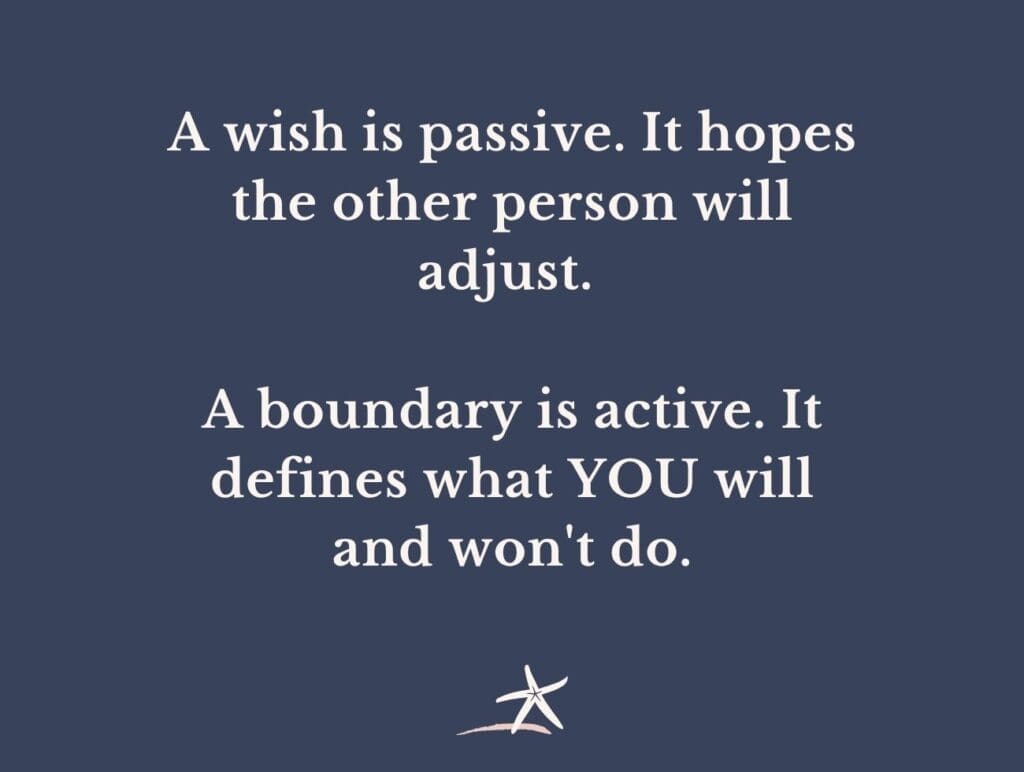
A wish is passive. It hopes the other person will adjust. It says I’d prefer if… and then waits to see what happens. When it doesn’t stick, the person with the wish quietly absorbs the disappointment and tells themselves they’ll try again later, or the other person just isn’t ready, or maybe the timing was wrong.
A boundary is active. It defines what YOU will and won’t do, not what you’re asking others to do. Carla can’t set a boundary that says Brian won’t text after 6 PM. She can set a boundary that says I won’t respond to work messages after 6 PM. That’s the shift. It’s choosing to stop trying to manage other people’s behaviour and start owning your own.
It also sounds different.
A wish says, “I’m really trying to be better about after-hours work.” A boundary says, “I’m not available by text after 6 PM. If something is urgent, here’s what to do.”
A wish: “I’d appreciate it if assignments came in on time.” A boundary: “The deadline is Friday at noon. Work submitted after that receives a late penalty.”
For some of you, one of those sentences makes you anxious just to read it let alone do it yourself. That anxiety is the broken playbook talking. It’s telling you that clarity is harshness, that standards are unkind, and that a woman who holds her ground is being difficult.
That’s completely wrong. Clarity is kindness. Standards are leadership. And the woman who holds her ground is the one her team actually trusts.
What I do differently now
After Derek, I made a commitment to only say what I mean and mean what I say. And to do so the first time, clearly, and without apologizing for it.
In practice, that looks like this:
I decide the standard before the conversation, not during it. Because in the moment, when someone is warm and grateful and has a really compelling reason, my instinct is still to soften. So I decide ahead of time what is and isn’t flexible. That way I’m not making a call under pressure.
I separate caring from complying. I can care deeply about someone’s situation and still hold the standard. Those two things are not in conflict. In fact, the most caring thing I can do for the people I lead is be consistent because consistency is what makes them feel safe.
I let the discomfort be there. The first time you hold a standard you’ve been letting slide, it feels wrong. Someone is disappointed. There’s an awkward silence. You resist the urge to fill it with an apology. That discomfort isn’t a sign you’ve done something wrong. It’s a sign you’ve done something new.
The shift isn’t from generous to harsh. It’s from wishful to clear.
Your turn
This week, I want you to find one wish you’ve been calling a boundary.
Not five. One. The one that’s costing you the most. It may be those late-night texts, the missed deadlines, the meetings that eat your lunch hour. The one where your actions and your words have been saying two different things.
Write down what the boundary actually is. Not what you wish would happen. What you will and won’t do, stated plainly.
You don’t have to announce it to anyone this week. You just have to know it yourself because you can’t hold a boundary you haven’t decided on.
Comment below and tell me: what’s the wish you’ve been calling a boundary?
I read every response.

P.S. If this issue landed and you’re ready to go deeper, I have something coming for you. The First Boundary: The One That Changes Everything is a micro training designed for exactly this moment — when you know you need one real boundary and you want to get it right. Details coming soon. Click here to get on the waitlist.
