



Regular Check-ins Eliminate Surprises (the kind that start with “I quit”)
Issue #16
By Debbie Lawrence
Read Time: 7 minutes
Becka was a student in my Leadership Communications program who had been working 60-hour weeks for three years.
She cared deeply about her team. She was constantly available so she was known for responding to every call, every crisis, and every question. If you’d asked her whether she was a good leader, she would have said yes without hesitation.
Then her best performer quit.
I encouraged Becka to do an exit interview and this is what she heard: “Becka, I never know where I stand with you. I go weeks without feedback. I don’t know if you’re happy with my work or disappointed. I can’t work in the grey anymore. I need a leader who actually leads.”
Becka went home that night and cried.
She couldn’t even argue with this feedback because her now ex-employee was right. Becka didn’t give consistent feedback nor did she hold regular check-ins. It seemed that some people got her attention constantly while others went weeks without meaningful contact.
Rather than leading, Becka was reacting and her best performer had decided she’d waited long enough for something that wasn’t coming so she went looking for it elsewhere.
What struck me when Becka told me this story was how she wasn’t failing because she didn’t care but because she didn’t have any semblance of a leadership operating system in place. Why is that important? Simply, without a system, all her good intentions kept disappearing into the chaos of daily operations.
What I’ve learned from decades of coaching
I’ve worked with a lot of women who lead who would describe themselves the way Becka did. It’s some version of ‘present, hardworking, heavily invested, and always available.’
But available and structured are two different things.
When there’s no rhythm for communication, what happens is that the people who are loudest or most visible get the most attention. Think the 80/20 rule in action. They’re typically the 20% of your team.
The people who quietly do their jobs go weeks without meaningful contact (the 80%). On top of that, performance issues linger because there’s never a consistent forum to address them and wins go unacknowledged because there’s no designated time to celebrate them.
The people who eventually leave are almost never the squeaky wheels. They’re the ones who expected you to notice them without being asked and at some point, they stop expecting it.
Becka’s situation wasn’t unusual. What she was missing was a rhythm, a system to support everyone’s efforts.

What changed
When Becka came to me for leadership coaching, I introduced her to something I call the Clarity Scaffold. It’s a structured rhythm for all your leadership communication so nothing falls through the cracks.
Initially she was skeptical. “Another system to manage? I barely have time for everything else as it is.”
But she was desperate enough to try.
The first month was rough. Her calendar looked intimidating with all those meetings blocked out. She felt awkward asking her team to come prepared with an agenda and some conversations felt stilted and weird. She almost stopped after Week 2. “This isn’t working. This isn’t me.”
But she’d committed to six weeks, so she kept going.
Week 4, one team member said: “I used to save up a month’s worth of questions and forget half of them. Now I know we’ll meet every week, so I can actually plan ahead.”
Week 6, Becka realized she hadn’t put out a single fire that week because problems had been addressed in one-on-ones before they became crises.
For the first time in three years, she went home on Friday without a pit in her stomach about who she’d missed or what she’d let slide.
Within 90 days, everything had shifted.
Six months later, her best performer called.
“When I heard you’d put a real communication structure in place, I wanted to give it another chance. What I needed all along wasn’t more of your time. I just wanted predictable, structured time.”
The monthly check-in
The Clarity Scaffold has four pillars. Weekly one-on-ones handle the day-to-day. But one of the most important pillars is the monthly performance check-in, and it’s the one leaders who are doing weekly check-ins most often skip.
This is where you zoom out.
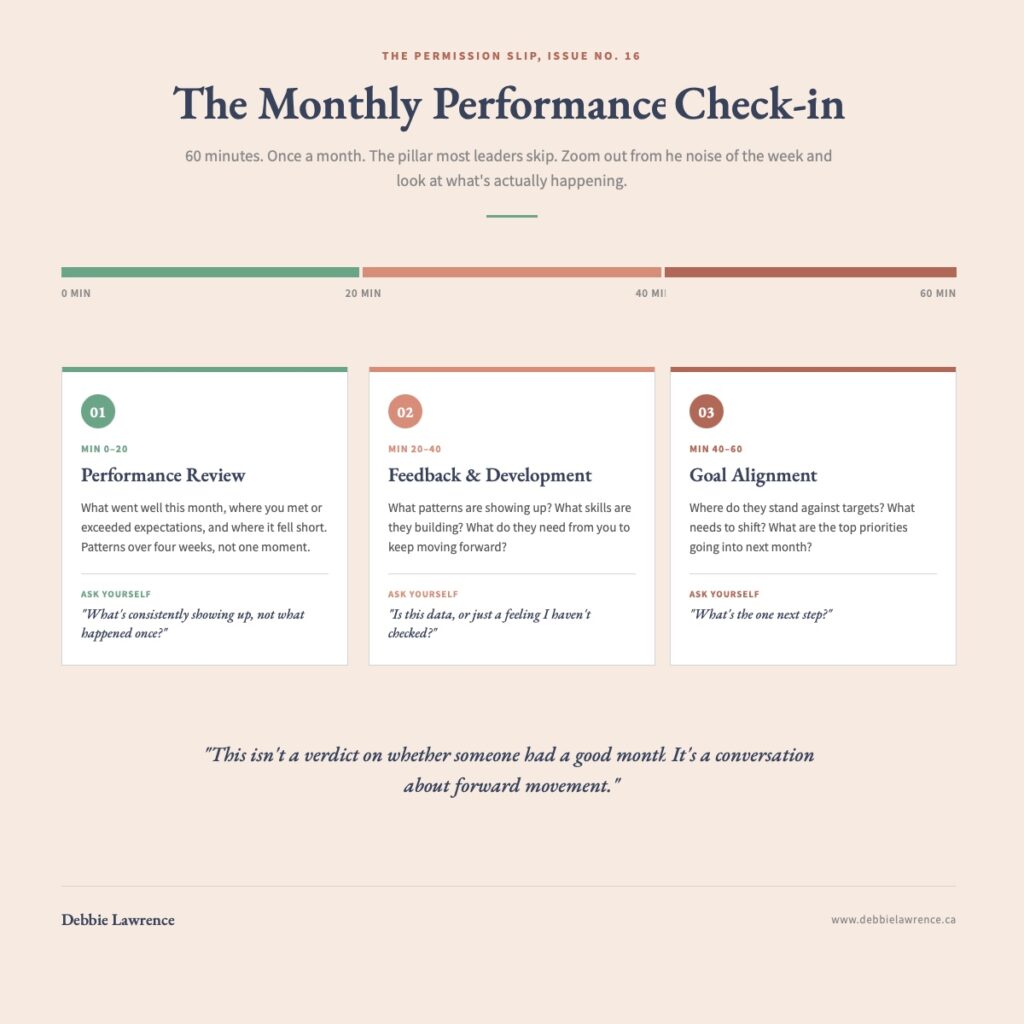
Once a month, you sit down with each team member for 60 minutes and look at the bigger picture. Rather than focusing on today’s problem or this week’s update, the monthly performance check-in looks at the patterns over the last four weeks.
The first 20 minutes is a performance review. This is where you look at what went well this month, where performance met or exceeded what you expected, and where it fell short. You’re not reacting to individual incidents. Instead, you’re looking at what’s consistently showing up.
The next 20 minutes is feedback and development. What patterns have you been noticing? What skills are they building? What do they need from you to keep moving forward?
Think of it as keep – start – stop. What should they keep doing because it works. What should they start doing to up-level their performance? What should they stop dong because it’s holding them back or keeping them stuck or simply not helping to produce the results you need to see from them?
The final 20 minutes is goal alignment. Where are they against their targets? What needs to shift? What are the top priorities going into next month?
Three rules that make it work
The first rule is no surprises.
Nothing in a monthly check-in should be brand new information. If someone has been missing deadlines, you address it in real time or in a weekly one-on-one. The monthly check-in is for patterns, not individual incidents. It’s where you say: “I’ve noticed over the past four weeks that X keeps happening. Let’s talk about what’s going on and what needs to change.”
If it’s the first time they’re hearing about a problem, you’ve already missed the window for feedback.
The second rule is bring data, not feelings.
“You’re struggling with time management” is not feedback. “In the past month, you’ve missed three deadlines: the Martinez report on the 5th, the client presentation on the 12th, and the budget review on the 23rd. Walk me through what’s been getting in the way” is a conversation worth having.
It’s specific, observable, and factual. Your feelings about someone’s performance matter less than the evidence.
The third rule is make it developmental.
This isn’t a verdict on whether someone had a good month or a bad one. It’s a conversation about forward movement. If someone is performing well, what’s the stretch for them? What’s the next skill to build? If someone is struggling, what’s the one thing they can focus on this month?
Development means there’s always a next. Always.
What this feels like on both sides
When there’s no rhythm, your team is playing a guessing game. Am I doing okay? Does she think my work is good? Should I be worried?
They get blindsided at annual reviews with feedback they’ve never heard before. They don’t know whether course-correcting is possible because nobody’s told them they’re off course.
With monthly check-ins, that changes. They know where they stand. They know what’s working and what needs attention. They can adjust in the moment rather than learning about a problem six months after the fact. They feel like you’re invested in their success.
For you, the monthly check-in means you stop carrying around that vague dissatisfaction with someone’s performance without ever saying it out loud. You stop avoiding the hard conversation until you’re so frustrated you say it badly. You have a designated time and place to address patterns, which means the feedback actually happens.
And the documentation matters more than most leaders think.
After every monthly check-in, send a follow-up email in a summary: “Here’s what we discussed: [what’s going well], [areas for development], [priorities for next month]. Let me know if I missed anything.”
This creates shared clarity. When annual review time comes, you’ll have a record of every conversation you’ve had rather than trying to reconstruct six months from memory. And your team can’t tell you six months from now that they never heard something, when you have the emails to show otherwise.
Your turn
If you’ve been leading the way Becka was before, you know the feeling she was describing. Working hard, deeply invested, genuinely available. And still somehow missing the people right in front of you.
Rather than fearing that this kind of structure could be seen as a sign that you don’t trust your team, in reality it lands as a sign that you take them seriously and that they matter.
Start with one person this month. Block 60 minutes on the calendar and frame it as a monthly performance check-in. Come prepared with specific observations from the last four weeks, ask them to come prepared with theirs, and see what happens to the conversation.
Comment below and tell me: do you have a regular check-in rhythm with your team right now? And if you try a monthly performance check-in, I want to hear what shifts.
I read and reply to every response. And I love hearing from you.

You can also listen to this issue on The Compassionate Leader School podcast episode, which drops the same day on Apple Podcasts, Spotify, and all major platforms. Click here to explore all the episodes.
