
Why Avoiding Hard Conversations Makes You A Worse Leader
Issue 02
By Debbie Lawrence
Read Time: 8 minutes
Over 30 years ago, I was sitting in my office as a marketing director, staring at a calendar deadline that was two days away.
I had an experienced team member—let’s call him Calvin. He’d been in marketing longer than I’d been alive. He knew his stuff. And I desperately wanted him to like me and respect me as his director, despite my age and relative inexperience.
Two months earlier, I’d assigned him the ad copy for an annual publication that went out to prospective clients. This was before the internet mattered the way it does now, so print was everything. The deadline had always been firm: March 15th. Printing schedules don’t negotiate.
For two months, I said nothing. I didn’t check-in or ask “how’s it going?” There were no milestone reviews.
Why? Because I thought checking in would signal I didn’t trust him and I believed experienced people didn’t need follow-up. I also wanted to be the director who gave people autonomy and freedom. I wanted him to see me as capable and as someone who didn’t micromanage.
I called it trust. It was really avoidance.
Two days before the deadline, I finally asked how the copy was coming.
His response: “I haven’t started yet.”
Panic set in. We scrambled and I ended up writing half of it myself at the last minute. The quality was subpar because we were rushing and the whole thing felt like a mess. And worse, I felt like I’d failed as a leader.
The conversation that changed everything
When I asked Calvin why he’d waited so long to start, he looked me straight in the eye and said something I’ll never forget:
“You’re the director here, right? If you knew the deadline was approaching, why did you leave it so late to follow up with me?”
I cringed. It felt like role reversal. And he was right.
Then he asked: “Why didn’t you follow up earlier if the deadline was so important?”
That led to a conversation about accountability—his AND mine. We talked about how my silence had communicated that the deadline wasn’t real and the work wasn’t urgent. I also saw how in that situation I wasn’t leading. I was just hoping he’d figure it out.
When I admitted “I didn’t want to push too hard,” Calvin was blunt: “That’s your story, not mine. I didn’t think you were micromanaging. I thought the deadline wasn’t firm.”
And there it was.
The lesson I learned was that I was the one who made following up mean I didn’t trust him, not Calvin.
My avoidance wasn’t protecting our relationship. It was avoiding my discomfort at the expense of both of us.

The pattern I see everywhere now
I see this same pattern with so many of the woman leaders I work with.
She avoids the hard conversation, not because she’s unkind, but because she has confused protecting someone’s feelings with protecting herself from discomfort.
Underneath her choice to, in essence, dodge the conversation is a desire to not have to feel the tension that would come up if someone pushed back or to avoid figuring out what to do if someone cries. At other times it’s to sidestep being seen as “too demanding” or “difficult.”
This choice not to have the hard conversation gets labeled as kindness and compassion.
In reality, it’s conflict avoidance driven by fear. And in practice it looks like this situation that arose with one of my clients:
Victoria managed a team of eight. Darcy was one of those eight, and she kept missing deadlines. Proposals went out with typos and incorrect client names. Work that should have taken two hours was taking two days, and Victoria was now reviewing everything before it went out, which only added more to her already full plate.
Victoria saw it. She felt the knot in her stomach every time Darcy submitted something for approval but she didn’t say anything.
Why? Because Darcy was going through a divorce. Because Victoria didn’t want to seem “too demanding.” Because she told herself: I don’t want to make her feel worse. I’ll just fix it myself this time.
Six months later, after Darcy’s work cost them a major client, Victoria had had enough. In a not-so-gracious moment, she unloaded six months of frustration in ten minutes.
Darcy was blindsided. “Why didn’t you tell me sooner?”
In that moment, Victoria didn’t know how to respond.
What Victoria learned too late was how her avoidance wasn’t kind. It was cruel to Darcy (who never got feedback she needed), cruel to the team (who watched standards get lower and lower), and cruel to Victoria herself (who suffered in silence while her business struggled).
The kind choice would have been having the conversation six months earlier. Clear, direct and compassionate.
Why we keep avoiding
The reasons leaders avoid these conversations all sound reasonable in the moment:
“If I bring this up, resentment will last forever. Trust will break. Everything will be awkward from now on.” So silence becomes the choice, and the relationship dies slowly instead of getting the honesty that might save it.
“I don’t know what to do when they cry or get defensive or push back.” Avoidance feels safer because at least there’s no pressure to navigate emotions nobody knows how to manage.
“Maybe it’ll resolve itself. Maybe it’s better to let it go. Maybe silence keeps the peace.” So the issue festers until it’s unfixable, and then confusion sets in about why everything fell apart when you were “trying so hard to keep the peace.”
“The job market is tight, hiring is expensive, and we’re already stretched thin.” Tolerating subpar performance feels like the only option. The hope is that maybe they’ll magically improve without anyone having to say anything.
They won’t.
The real cost nobody talks about
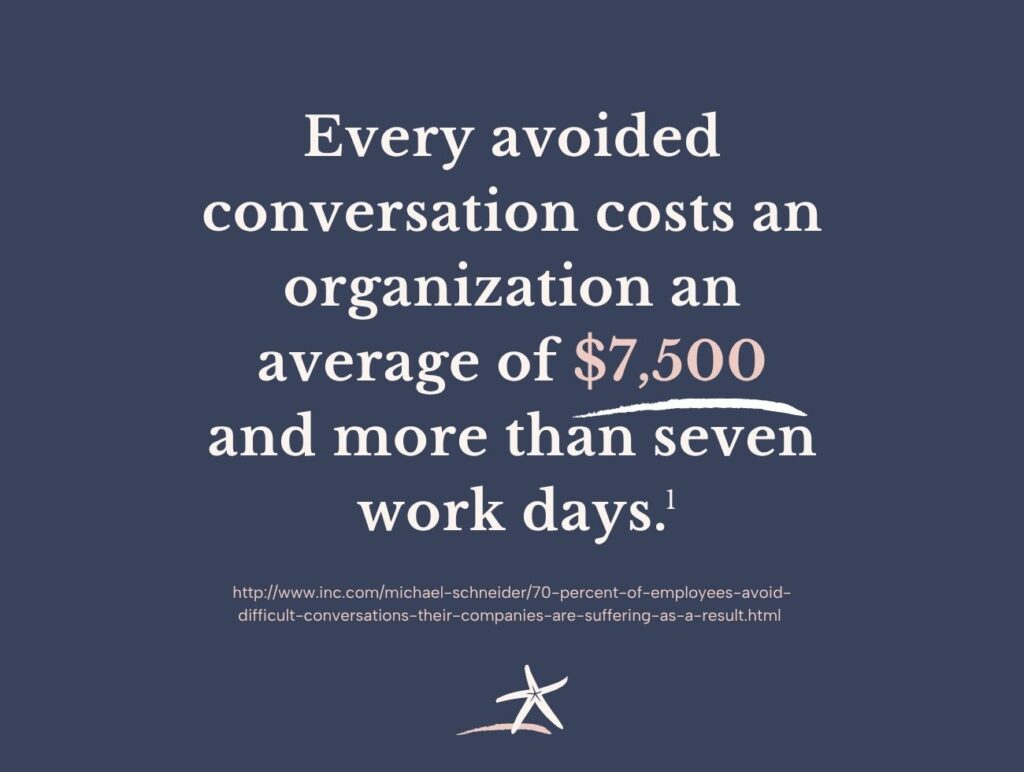
Here’s the number that should make you pay attention: Every avoided conversation costs an organization an average of $7,500 and more than seven work days.^1
That’s not my number. That’s research.
Every silence about the missed deadline, the subpar work, the unprofessional behavior bleeds time, money, and trust. The cost is measurable.
But the cost that can’t be measured is the one that gets felt daily: the slow erosion of leadership credibility.
Every time silence gets chosen over honesty, the team learns that standards don’t matter and accountability is optional. That mediocrity will be tolerated as long as nobody has to feel uncomfortable.
For the person being avoided, there’s no awareness there’s a problem. Everything seems fine. They keep doing what doesn’t work, wondering why advancement isn’t happening, why better projects aren’t coming, why trust feels absent. They’re being allowed to fail while being told everything’s okay.
For the leader avoiding the conversation, resentment builds with every silent day. Respect erodes, for them and internally with the whole team. Hours get spent compensating for the employee’s performance instead of addressing it and nights involve lying awake, rehearsing conversations that she knows deep down won’t happen the next day.
For the team watching it all unfold, they see what shouldn’t be tolerated getting tolerated. Standards become negotiable, high performers lose respect and some quietly start job searches for places where excellence matters.
The truth is that silence isn’t kindness. It’s permission. Permission for the problem to continue and for standards to slip. It’s permission for the person to keep failing without knowing why.
What I did differently the next time
After the Calvin disaster, I made myself a rule: If something matters enough that I’d be frustrated if it doesn’t happen, it matters enough to follow up on.
The next time I delegated something with a firm deadline, I scheduled check-ins before I even handed off the work because I’d learned that follow-up isn’t about trust. It’s about clarity.
I started conversations differently too. Instead of avoiding feedback until I exploded, I created a simple framework for myself:
Observation: “Here’s what I’ve noticed…”
Impact: “Here’s how it’s affecting the work/team/business…”
Forward: “Here’s what needs to change going forward…”
There’s no elaborate script. There’s also no such thing as perfect timing. It’s just about being direct and being clear.
The first few times I applied this approach, it felt uncomfortable. I worried about being seen as demanding. I second-guessed whether I was being too direct.
But here’s what actually happened: People thanked me.
They said things like, “I wish you’d told me this sooner.” Or “I had no idea this was an issue. I can fix this.”
Turns out, most people don’t want to fail in the dark. They want to know where they stand.
The bottom line
Looking back at that conversation with Calvin, I realize he did me a favor. He held up a mirror and showed me that MY story about follow-up—not his—was the problem.
I’d made checking in mean I didn’t trust him. I’d made giving feedback mean I was being demanding. I’d made having standards mean I was difficult.
None of that was true but it took failing badly to see it.
Here’s my question for you this week: What conversation have you been avoiding?
Not the biggest, not the scariest—just one that matters.
Maybe it’s:
- The team member consistently late to meetings
- The person whose work quality has dropped
- The colleague who interrupts everyone
- The direct report who’s checked out
You already know who it is. You’ve known for weeks, maybe months.
This week, schedule that conversation. Not “when timing is better.” Not “after you figure out exactly what to say.” This week.
Start with: “I need to talk about something I should have brought up sooner.”
Then share what you’ve observed. Be specific. Be clear. Be factual. Be kind.
Will it be uncomfortable? Probably. Might they get emotional? Maybe. Could you handle it imperfectly? Absolutely.
None of that means you shouldn’t have the conversation. It means leadership is finally happening because you’re caring enough to be honest.
The goal isn’t perfection. The goal is to stop confusing silence with kindness because staying quiet isn’t protecting them. It’s failing them.
Your turn: Comment below: What conversation have you been avoiding?
You don’t have to tell me why you’re avoiding it. Just name it. That’s the first step.
I read and respond to every response.