



What My Annoyance Knew Before I Did
Issue #28
By Debbie Lawrence
Read time: 9 minutes
Every month, the email came.
“I think I messed up the formula in cell F14. Can you fix it for me, please?”
I’d built my client Courtney a spreadsheet to track her monthly projections against her actuals. Her job was to enter the real numbers in the column beside the projections, and the formulas would do the rest.
Except the formulas kept breaking as she edited the spreadsheet.
And every time I fixed them I had a flood of thoughts. She’s paying me for this. It’s a service. It only takes 2 minutes. I don’t want to make this harder for her.
If I’m honest, there was something else going on too. Every one of those emails gave me a little hit of dopamine. I know exactly how to fix this. I can rescue her.
This occurred several times a month over the course of 3 months.
Then one morning I received several emails from Courtney within a 20-minute span. “I hate to ask you again. This is the third one today and it’s not even 10:00 am. I keep messing up. I hope I’m not bothering you.”
That’s when I felt it, that small flicker of annoyance.
Over the years, I’ve learned to listen to the whispers. I no longer need something to shout at me before I pause, so I paused and looked closer.
That’s when I saw what I’d missed. Courtney knew her way around a spreadsheet. She just couldn’t see what the formulas were supposed to do so she couldn’t fix them when she accidentally altered one of the elements. For her, it was like reading a foreign language. Every month, I translated one more word for her, and she was no closer to reading it herself.
I’d been fixing cells. Without meaning to, I’d also been training her to need me.
So I suggested a training session where I walked her through what each formula was doing and why.
The first time she hit a snag after that, she emailed me, same as always. This time I set up a Zoom call so she could share her screen and walk me through what she understood. I watched and asked questions, and she fixed the problem herself.
Later she said something I haven’t forgotten: “I was so used to reaching out, and you’d just fix it. You made it easy for me. It was easier to email you than to sit and figure it out myself.”
Part of me heard “you made it easy” and felt proud. Then I heard the rest of the sentence.
It took a few more calls like that where each time, I reminded her of what she already knew and asked her to try first. I told her that if she was truly stuck, she should call me, and I meant it. But I also knew she could do this.
Eventually, she did and the spreadsheet became hers.
Swap “client” for “team member,” and I suspect you’ve lived this exact scenario.

The name for what I was doing
That flicker of annoyance sent me back to my bookshelf.
Years ago, I trained with Harriet Lerner. I’ve read The Dance of Anger several times, and a few weeks ago I pulled it off my shelf again.
Lerner teaches that anger is a signal worth listening to. It tells you something in a relationship needs your attention. That’s exactly what my annoyance was doing. It was telling me I’d been fixing something that belonged to Courtney, not me.
Lerner has a name for what I’d been doing. She calls it overfunctioning.
An overfunctioner moves in fast. She advises, rescues, takes over, and fixes. She knows what’s best, and when things get hard, she’s the one who handles it. It looks like competence and feels like care.
Underneath, it’s a response to anxiety. When something feels uncomfortable, the overfunctioner does something, and doing something calms her down. That little hit I got every time I fixed a formula? That was the relief.
Overfunctioning has a partner: underfunctioning. The underfunctioner steps back. She gets less confident in that area and waits for someone else to handle it.
Lerner describes the two as a dance. The more one person does, the less the other does, and each move makes the next one more likely. Both people are reacting to the same anxiety and just move in opposite directions.
Courtney was doing exactly what our dance had taught her. Every email I answered with a fix made the next email more likely.
Lerner wrote about families and couples, but when I work with leaders and their teams, I see this same dance play out again and again.
The pattern I often see
So many of the women I coach are expert overfunctioners. They’re the ones who get the email at 9pm and quietly handle it before bed.
And the reasons they give me make complete sense. They’re reasons I’ve told myself, too:
“It’s faster if I just do it.” And it is, today. Then it’s 2 more minutes next week, and the week after that. You end up paying those 2 minutes forever.
“I don’t want to overwhelm her.” It feels kind in the moment, but every rescue tells her you don’t think she can handle it, and after a while she starts to agree.
“Supporting my team is my job.” It is. The support that lasts is the kind that leaves someone more capable than they were before.
“I’m good at this.” You probably are, and that’s the trap. Your competence becomes the reason no one else has to build theirs.
All of these sound reasonable. All of them keep the dance going.
And that’s how you end up at your kitchen table on a Sunday night, doing everyone’s work and wondering why no one steps up.
Why this dance is harder to leave when you’re a woman
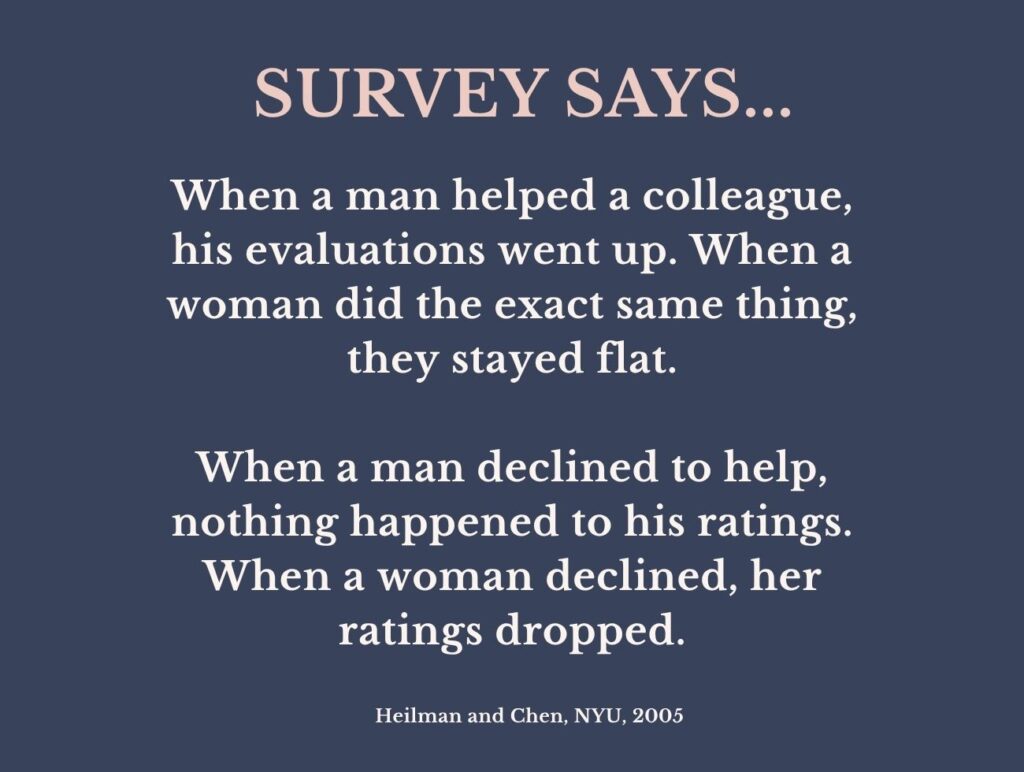
In 2005, psychologists Madeline Heilman and Julie Chen at NYU tested how people judge helpful behaviour at work.
When a man helped a colleague, his evaluations went up. When a woman did the exact same thing, they stayed flat.
When a man declined to help, nothing happened to his ratings. When a woman declined, her ratings dropped.
A third study explained why. It showed how people see helping at work as more optional for men than for women.
In 2017, economist Linda Babcock and her colleagues found the pattern still holding. Women volunteer more often for work that won’t get them promoted. They’re also asked more often, and when they’re asked, they say yes more often.
When one university emailed its faculty looking for committee volunteers, 7% of the women signed up. For the men, it was 2.6%.
The reason? Everyone expects women to say yes, so people tend to ask women.
In my work with women who lead, I see what comes next. Later when she thinks about stepping back, the fear shows up fast: They’ll think I’m selfish. Uncaring. Not a team player.
Of course you overfunction. The broken playbook practically requires it.
The differentiated leader
Lerner showed me the dance. Edwin Friedman showed me how to lead my way out of it.
Friedman was a rabbi and family therapist. He took the same family systems thinking behind Lerner’s work and applied it to organizations. In A Failure of Nerve, he describes the leader every team needs. He calls this the differentiated leader.
In plain language, this is a leader who’s clear about what’s hers to carry and clear about what belongs to someone else. She stays connected to her people and cares about how they’re doing. And she lets them carry what’s theirs.
Friedman describes this leader as a “non-anxious presence”. When things get tense, she stays steady and gets that her team’s anxiety isn’t hers to fix.
Think back to Courtney. The overfunctioning version of me felt the worry in her email and rushed to make it go away. The differentiated version felt the same pull, stayed steady, set up the Zoom call, and let her find the answer.
Same care. Different move.
What I do differently now
The humbling part? I already knew this.
As a coach, I’ve worked by the same guideline for years: when someone brings me a problem that’s theirs to solve, I hand it back with support. It applies to leadership just as much.
And I still slid right back into fixing.
That’s how this work goes. You can know something deeply and still slip into old behaviours, especially when the slip comes with a little hit of feeling helpful. That hit was real, and I still feel the pull.
You can’t become a non-anxious presence just by deciding to. The pull to fix shows up in your body before your brain has a chance to weigh in, so here’s what I do now:
I ground myself first. When the email arrives or the phone rings, I notice the pull before I act on it. I take some deep breaths and place my feet on the floor. A few seconds is enough. In Issue #17, I wrote about nervous system regulation, and this is where it earns its place. When I feel grounded in my body, I can feel the pull without obeying it. I just let it be and then slowly the strength of the pull lightens.
I catch the thought. Regulation gives me the pause. Thought work tells me what to do with it. Once I name the thought behind what I’m feeling, I get to decide whether it’s serving me. It’ll only take 2 minutes sounded helpful, but it also kept Courtney emailing me for 3 months. If a thought isn’t serving me, I can reframe it by changing how I think about the situation. (That’s a whole issue on its own, and it’s coming.)
I ask before I answer. “Walk me through what you understand.” Often the person already has more of the answer than either of us expected.
I expect the pushback. Lerner teaches that when you stop overfunctioning, the dance fights back. She calls these “change back!” reactions. Your team may bring you more problems for a while, and your own guilt will get loud. Courtney emailed me the very first time she got stuck after our training. That was the dance asking me to take my old step. Friedman saw the same resistance in organizations, and it usually means the change is working. So I stay connected, I stay steady, and I let them keep what’s theirs. The guilt is a growth indicator. It shows up because I’m doing something new.
And I always say this part out loud: “If you’re truly stuck, reach out.” Stepping back and staying connected can happen at the same time.
Your permission slip
You are allowed to let someone else carry what’s theirs.
You are allowed to feel the pull to fix it and stay where you are.
You are allowed to trust that your team can figure it out.
You are allowed to care deeply about your people and still hand the problem back.
Handing back what isn’t yours is a boundary, and boundaries get tested. That’s what I’m teaching inside The First Boundary: The One That Changes Everything, a micro-training launching this fall for $67. It walks through exactly where the line sits and what to say the third time someone comes back looking for the old you.
The waitlist is open now. Click here to get on the waitlist.
Your turn
This week, the next time you feel the pull to fix something that belongs to someone else, pause. Ground yourself first. Then grab a notebook (or the notes app on your phone) and set a timer for 5 minutes.
Write down every thought running through your head. Keep going until the timer goes off. Messy is fine.
Then read it back and notice where your own flicker of annoyance shows up, even a small one. That’s your signal that you may be carrying something that isn’t yours.
Now circle the one thought that makes you want to reach for the fix.
Ask yourself: is this thought serving me, or is it keeping the dance going?
That thought is where your overfunctioning starts. You can’t change what you can’t see.
Comment below and tell me the thought you circled. I’d bet it sounds a lot like mine.
I read and reply to every response. And I love hearing about what you’re learning.

P.S. You can also listen to this issue on The Compassionate Leader School podcast episode, which drops the same day on Apple Podcasts, Spotify, and all major platforms. Click here to explore all the episodes.
