



The Five Phrases Quietly Undermining Your Requests
Issue #29
By Debbie Lawrence
Read time: 8 minutes
Patricia runs a 12-person advocacy organization, and she has one sentence to send.
Her program coordinator keeps submitting grant reports 24 hours or less before they’re due. They should take Patricia 30 minutes to review but every one of them takes 3 hours of rewrites, because whole sections are thin or missing.
So she opens her email and types it:
“I need grant reports 48 hours before the deadline.”
She looks at the sentence sitting there on its own. It looks so bare.
That sounds cold. She’s juggling a lot.
So Patricia adds “When you get a chance…”
Then “If it’s not too much trouble…”
Then, at the end, “I know you’re juggling a lot, so no worries if that doesn’t work!”
She reads it back and sees what she’s done. In three edits, she’s turned a requirement into a suggestion and written her coordinator a polite way out of it.
She deletes the whole thing and starts over. Then she starts over five more times.
Patricia told me all of this in one of our coaching sessions. She never sent the email.
The day before, her coordinator’s latest grant report had landed 18 hours before the deadline. Patricia stayed up until midnight fixing it.
The ask that talks itself out of happening
Patricia knew exactly what she needed and she had every bit of authority to ask for it.
What stopped her was the moment the clear sentence showed up on her screen and her conditioning read it back to her. Too demanding. Too controlling. Don’t offend her.
So she softened it until there was nothing left to send.
The pattern I see everywhere
Patricia has plenty of company.
Jennifer manages 15 people across two boutique locations. Her assistant manager, Casey, has been 45 minutes late three times this week. Yesterday a customer waited ten minutes for someone to unlock the fitting rooms. Jennifer types “Casey, you need to be here at 9 AM for opening. No exceptions.” and deletes it. Too harsh. She types “Hey! I noticed you’ve been running a bit late lately…” and deletes that too. Too soft. Ten minutes later she still hasn’t sent anything. Casey is late again the next morning.
Dr. Chen owns a family practice with six staff. Her office manager, Kyle, takes personal calls at the front desk, some of them 15 minutes long, while patients wait to check in. For three days, Dr. Chen has been rehearsing one sentence in her car: “No personal calls at the front desk during patient hours.” She still hasn’t said it and yesterday a patient complained.
These are three capable leaders in three different industries. Each one knows what she needs and has the authority to ask but the ask just won’t come out clean.
When I dig into it with clients, the reasons tend to sound like this:
“I don’t want to sound demanding.” Somewhere along the way, a lot of us learned a progression. A direct request makes you demanding. Demanding makes you difficult. Difficult makes you unlikable, and unlikable leaves you alone. Being unclear felt safer than being alone.
“There’s no way to say it that isn’t harsh.” This one assumes there are only two choices: be vague and nice, or be direct and mean. Given those two, most women who lead will pick vague and nice every time.
“I don’t want them to feel pressured.” So she manages how they’ll feel before they’ve felt anything. It looks considerate. In practice it puts their comfort ahead of what the work needs. Every. Single. Time.
“What if they say no?” A clear request can be turned down, and then you’d have to negotiate, hold firm, or make a decision. A vague one is much harder to refuse, because nothing was really asked. When it doesn’t get done, you can tell yourself it was never a requirement anyway.
All four sound reasonable. All four leave Patricia at her desk at midnight rewriting yet another grant report.

Why the apology comes so easily
In 2010, psychologists Karina Schumann and Michael Ross at the University of Waterloo asked people to keep a daily log of the things they’d done that might call for an apology, along with the apologies they gave.
The results were published in Psychological Science. What they saw was that women apologized more often than men. When the researchers looked closer, though, men and women apologized at about the same rate for the things they believed were offensive. The difference was in what counted. Women saw more of their own everyday behaviour as needing an apology. Men had a higher threshold for what they considered offensive, so they apologized less often overall.
I see that lower threshold in almost every softened request that gets explored in a coaching session. To the woman writing it, “I need the report by Friday” registers as blunt. It feels like an imposition. And an imposition gets an apology, a cushion, and a way out.
The anatomy of a weak request
When I work with leaders on this, I like to take one clean sentence and pull it apart.
Start here: “I need the budget review by Friday.”
Now watch what happens once the conditioning gets hold of it:
“I’m sorry to bother you, but would you possibly have time to maybe look at the budget review when you get a chance? No rush at all, whenever it works best for you! Thanks so much, you’re amazing! But if you can’t, that’s totally fine!”
Every piece of that second version is doing a job. Here are the five phrases I see most often, and what each one tells the person reading it.
The apology. “I’m sorry to bother you…” This says your request is an imposition. Over time, they learn your asks are burdens, separate from the real work.
The optionality. “Could you possibly… Would you mind… If you have time…” This says the work is up to them. So they do everything else first, because this one sounded negotiable.
The timeline softener. “When you get a chance… No rush… Whenever works for you…” This says there’s no deadline. And “whenever” has a way of turning into never.
The excessive gratitude. “Thanks so much! You’re the best!” This says they’re doing you a personal favour by doing their job. Ordinary work starts to look like extraordinary effort.
The escape clause. “But if you can’t, that’s totally fine!” This says the thing you just asked for isn’t necessary. And they take you at your word.
Put all five together and here’s the message that lands: This doesn’t really matter. Feel free to skip it.
Now go back to Patricia’s email. “When you get a chance” was a timeline softener. “If it’s not too much trouble” was optionality. “No worries if that doesn’t work” was an escape clause. She built three of the five in under a minute without noticing, which is exactly how it happens for so many of us.
The option most of us were never shown
On some level, most of us believe the choice is between two ways of asking.
Nice and ineffective sounds like “So sorry to bother you, but when you get a chance, if it’s not too much trouble, could you maybe take a look at this? No rush!” People like you. Nothing gets done, and you burn out doing everyone’s job.
Effective and mean sounds like “This is due Friday. I don’t care what else you’ve got going on. Get it done or we’re going to have a problem.” Things get done. People resent you, and the culture turns toxic.
There’s a third way, and it’s the one that never made it into the broken playbook.
Clear and respectful sounds like “I need the budget review completed by Friday at 5pm. Let me know if there’s anything blocking you from meeting that deadline.”
It says what you need and when. It offers support. It skips the apology, the qualifiers, and the escape clause, because none of them were ever needed. People know what’s expected, the work gets done, and you keep their respect.
Brené Brown says it plainly: “Clear is kind. Unclear is unkind.”
What I do differently now
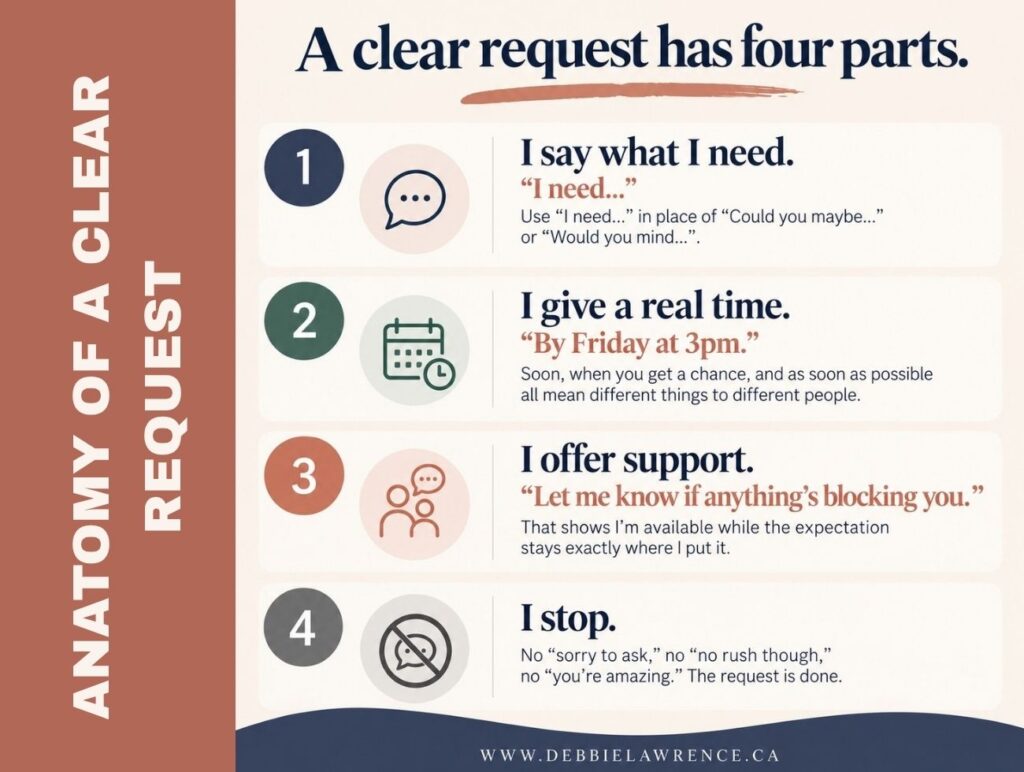
When I make a request, it has four parts.
I say what I need. “I need…” in place of “Could you maybe…” or “Would you mind…”
I give a real time. “By Friday at 3pm.” Soon, when you get a chance, and as soon as possible all mean different things to different people.
I offer support. “Let me know if anything’s blocking you.” That shows I’m available while the expectation stays exactly where I put it.
I stop. No “sorry to ask,” no “no rush though,” no “you’re amazing.” The request is done.
Writing it is the easy part. The hard part is the five seconds before you hit send, when the voice starts up: That sounds harsh. Let me just add… What if they think…
So I notice the urge and name it to myself: I feel the urge to soften this. Then I ask three questions. Am I asking them to do their job? Is the timeline realistic for the scope? Have I been clear about what I need? If all three are yes, the discomfort I’m feeling is old conditioning talking. I just let it sit with me for a moment, knowing it will pass within a few minutes.
Then I send it and close the email. I don’t reread it, and I don’t follow up with “Sorry if that came across wrong!”
The first few times you do this, it will feel uncomfortable, even awful. Too harsh. Too much. That feeling is what breaking old conditioning feels like from the inside.
And here’s what happens, in my experience with hundreds of leaders, about 95% of the time: the person they’re sending this to responds with “Got it.” Or “On it.” Or “Will have it to you Thursday.”
The other 5% of the time, someone says, “That timeline is tight. Can we do Monday?” And you have a conversation about it. That’s collaboration, and it’s a perfectly good outcome too.
Direct requests clarify relationships. In all my years of doing this work, I haven’t seen one destroy a relationship that was worth keeping.
Your turn
This week, pick one request you make over and over. Status updates, report submissions, meeting prep, or response times. Choose the one that frustrates you most.
Open a document and write two versions.
Version A is what you say now. Put in every apology, qualifier, and escape clause. Be honest.
Version B uses the four parts I outlined above: what you need, by when, an offer of support, and then nothing else.
The next time that request comes up, send Version B. Don’t soften it “just a little.” And when the panic hits right after you send it, don’t add “But if you can’t, that’s totally fine!” Don’t rescue yourself from your own clarity.
Comment below and tell me about your Version A. I want to see how many of the five phrases you find in it.
I read and reply to every response.
P.S. You can also listen to this issue on The Compassionate Leader School podcast episode, which drops the same day on Apple Podcasts, Spotify, and all major platforms. Click here to explore all the episodes.
