



The Feedback Lesson You Were Never Taught
Issue #31
By Debbie Lawrence
Read time: 8 minutes
Joanne had barely settled into our coaching session when she said, “I had this thing happen with a team member yesterday, and I keep replaying it.”
Late in the afternoon, Pauline had come to her office door. “Do you have a few minutes? There’s something I want to talk about.”
Joanne said yes, and Pauline sat down. She had some concerns about a work project. She was frustrated that it wasn’t progressing the way she wanted it to.
Joanne listened, and while she listened, she was already forming a plan.
Pauline’s discouraged, so I just need to reassure her and build her confidence back up.
So that’s what she did. She told Pauline that she saw how hard she’d been working and how much she’d been applying herself. “I’ve seen the progress,” Joanne said. “We’re not quite there yet, but I know we’re going to get there. I believe in you.”
It was warm and sincere, and Joanne meant every word of it.
At the end, she asked, “Was that helpful?”
Pauline paused. “Well, I appreciate that you appreciate me,” she said. “I guess that’s not exactly what I was looking for.”
“What were you looking for?”
“When you say I’m not quite there yet but I’m going to get there, I want to know what there is. What’s that benchmark and how close am I to it? And how are we going to close the gap?”
Joanne told me she just sat there for a second.
I thought I was helping.
She was helping. She just gave Pauline the wrong kind of help. Pauline had walked in wanting to know where she stood, and Joanne answered with how much she was valued. Neither of them specifically named what they were talking about, so the whole conversation missed the mark.

Feedback comes in three kinds
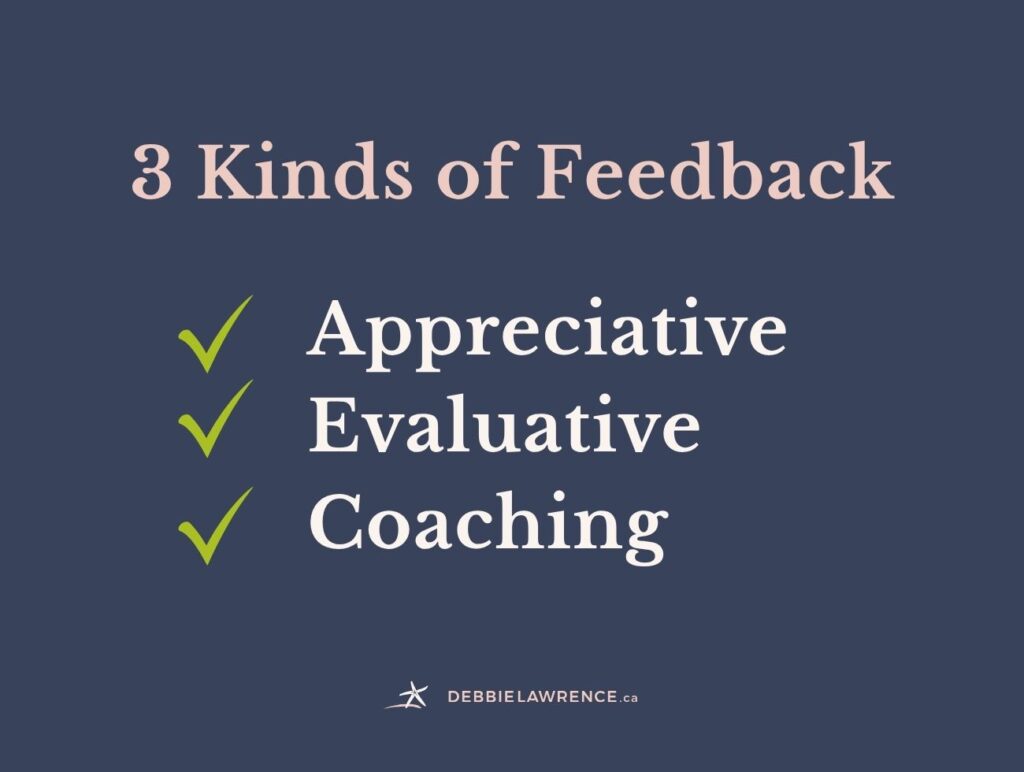
When I teach feedback, I start with a distinction from Douglas Stone and Sheila Heen’s book Thanks for the Feedback. In the workplace, we use one word, “feedback,” for what are three very different conversations.
Appreciative feedback says thank you, I see you, and you matter here. It’s about connection and it tells someone their effort is noticed beyond a simple thanks.
Evaluative feedback says here’s where you stand. It’s an assessment against a standard that tells someone how close they are to the mark and what that means for them. Most of you will recognize it because it’s what you offer in a classic annual performance review.
Coaching feedback says here’s how to get better. It’s about building a skill, closing a gap, and helping someone grow into what they are fully capable of.
Pauline wanted evaluative feedback, and that conversation would have led naturally into coaching that could have happened later. What she got was appreciation with one small piece of evaluation tucked inside it: We’re not quite there yet.
That one phrase was the part she heard most clearly, and it was also the part Joanne never explained.
Avoiding a cross-transaction
I call this a cross-transaction, and it happens two ways. Your team member wants one kind of feedback and you give them another. Or you intend one kind and they hear a different one. Once those wires cross, they’re hard to untangle.
When I dig into it with the leaders I coach, I hear these kinds of responses:
“I thought I could tell what she needed.” Joanne read Pauline’s frustration and made a call. Reading the room is a real leadership skill, which is exactly why it’s so easy to trust and miss the mark all at the same time. But frustration can point toward any of the three types of feedback. Sometimes a discouraged person wants to hear she’s appreciated. Just as often, she wants the truth about where she stands.
“I was trying to soften it with something positive.” Many of us were taught to wrap a hard message in praise. So the leader opens with appreciation, slips in an evaluation, and closes with encouragement. She thinks she’s being helpful and kind, but her team member walks out thinking, Was that a compliment? Am I in trouble? I’m not sure what that was.
“Feedback is feedback.” Plenty of capable leaders don’t know there’s more than one kind. If you were never taught the difference, you can’t teach it to your team, and they can’t ask you for what they need.
“I should just know.” Asking someone what kind of feedback they want can feel like admitting you don’t know how to lead. So the leader guesses, because guessing feels more confident than asking.
They all sound reasonable, but each one can lead to a cross-transaction that ends with someone like Pauline leaving her leader’s office feeling appreciated and still not knowing where she stands.
The hidden cost shows up later. A request for a conversation that doesn’t land teaches your team member that coming to your door might be a waste of time. Then the next time she’s worried about her work, she keeps it to herself, and the concern goes unaddressed.
Why blending muddies the water
Leaders tend to blend these types of feedback and there are two blends I see most often. The first is appreciation and evaluation in the same breath. It sounds something like this: “You’ve worked so hard on this and I really see the effort. The report isn’t at the standard yet but you’re such an asset to this team.”
The person on the receiving end hears all three sentences and can’t tell which one counts. Usually they decide it’s the middle one, and the appreciation evaporates. Or they hold on to the appreciation and miss the gap entirely. Either way, the message you meant to send didn’t arrive.
The second is evaluation and coaching. Stone and Heen describe someone who walks into her performance review expecting “exceeds expectations” and hears “meets expectations.” Whatever coaching follows, she won’t hear it because her mind is busy with other questions. What about all the times I covered for this team? What’s wrong with me? What does this mean for my raise?
Even when the coaching is designed to help her get to “exceeds” next year, it can’t compete with that internal voice until it is quenched.
To avoid this situation from occurring, I keep them apart. Evaluation comes first, because until someone knows where they stand, they can’t take in how to improve. Coaching comes later, ideally a few days later, once they’ve had time to absorb the rating. And appreciation gets its own moment too, without a “but” waiting at the end of it.

What I teach leaders now
The practice is simple. Name the kind of feedback before you give it.
That sounds like:
“I want to take a minute to tell you what I appreciate about how you handled that client.”
“I’d like to give you some evaluative feedback on where the project stands.”
“I want to set up a coaching session with you. I’d like to help close that gap we talked about regarding your time management of the project and strengthen your skills in this area.”
Partway through, check in: “I’m intending this as coaching. Is that how you’re hearing it? From where you sit, is that what you need?” If you each need something different, talk about it. That’s a negotiation, and it’s a much better conversation than the one where you both walk away confused.
The second half of this matters just as much. Teach your team the three kinds of feedback, so they have the language to ask for what they need. When Pauline comes to the door, she can say, “I’d like some evaluative feedback on the project. I want to know where I stand.” Joanne no longer has to guess.
And when someone doesn’t name it, you can ask. “Before I jump in, what would help most right now? Do you want to hear what I appreciate, where you stand, or would some coaching on how to move this forward be the most beneficial?”
If Joanne had asked that one question at the start, she’d have known in under a minute that Pauline was looking for a benchmark, which is evaluative feedback.
I’ll be honest. Labelling your feedback out loud feels clunky the first few times. It can feel formal, even a bit robotic. Do it anyway. Within a few weeks it starts to sound like how you talk, and your team starts speaking the words back to you.
Your turn
Think about the last time someone on your team asked, “Do you have a minute?” Which kind of feedback did you give them? Was it the kind they came for?
This week, take 10 minutes at your next team meeting to walk your team through appreciation, evaluation, and coaching. Then tell them that from now on, when they come to you for feedback, they can name which one they want.
Comment below and tell me which kind of feedback you default to when someone comes to your door.
I read and reply to every response.
P.S. You can also listen to this issue on The Compassionate Leader School podcast episode, which drops the same day on Apple Podcasts, Spotify, and all major platforms. Click here to explore all the episodes.
