



You’re Spending Your Best Hours in the Wrong Circle
Issue #22
By Debbie Lawrence
Read Time: 8 minutes
Juanita found out on a Thursday.
She’s a branch manager in Halifax for a professional services firm with its head office in Toronto. The email said the company was moving to yet another software system with the rollout starting in the fall.
Four years earlier they’d done exactly this. That implementation went badly enough that people still talk about it. There were the lost files, workarounds nobody documented, and a support line that rang through to a voicemail box that left her staff feeling frustrated when they couldn’t get immediate help with yet another bug in the system. All that dust had only just settled.
By the time we got on a call she’d been carrying her concerns about this upcoming round of software changes for about a week.
“I keep running through the scenarios,” she told me. “The rollout, the training schedule, who’s likely to quit over this, and whether they even considered the impact on anyone outside Toronto. I lie down at 10 at night and I’m still wide awake strategizing at 1.”
She talked about how she’d been in the meeting where the proposed upgrade got discussed. She’d been asked for her input, which she readily provided, and then the decision got made somewhere else, by more senior people whose table she wasn’t invited to join.
What she said next is very relevant what I want to talk about in this week’s newsletter.
“I should have pushed harder.”
She was running a full-time second job in her head, unpaid, on a decision that had already been made. What was keeping her up at 1 a.m. was every possible version of the rollout, running all at once, with no way to sort one concern from another.

The pattern revealed
When something big lands on us, we tend not to triage it. Instead, it’s as though we hold all of it with the same grip.
The parts we can act on today and the parts that were decided in a boardroom 1,200 kilometres away get exactly the same amount of attention, the same 1 a.m. rehearsal, and the same tightness in the chest. What that means is that the things we could actually move get only a portion of the attention they deserve.
I’ve watched a lot of capable women do this. I used to do it myself. From the outside it looks like diligence and it feels like diligence from the inside too, which just adds to this problem.
What tends to be underneath it all is some variation of:
“If I stop worrying about it, it means I’m fine with it.” Worry starts to feel like loyalty as if it’s proof you still care about the people it’s going to land on. Letting it go feels like consenting to it, so you keep the fire going as evidence of your own integrity.
“I need to be ready for the worst.” Running the disaster on a loop feels like preparation. I promise you, it isn’t. Preparation has a next step written down somewhere, and then another, and another. What you’re doing here is closer to anticipatory grief, where you rehearse the worst-case scenario and your response to it over and over.
“I was in the room. I should have changed it.” This one is the most expensive response because it ‘ disguised as accountability. You confuse having a voice with having a vote, and then you treat the outcome as a personal failure even though you only played a smaller role in the early discussion.
Every one of those makes sense from where you stand, which is why they have a hold on you.
Epictetus got there first
I read the Daily Stoic most mornings. August has been given over to Epictetus, and his central teaching is the one people keep coming back to 1,900 years later: sort what’s yours from what isn’t, and only spend yourself on what’s yours.
In their book by the same name, Ryan Holiday and Stephen Hanselman put Epictetus’ idea this way: “The chief task in life is simply this: to identify and separate matters so that I can say clearly to myself which are externals not under my control, and which have to do with the choices I actually control.”
I leaned on this hard in March 2020. Everything was unknown and none of it was mine. What I could do was offer support via Zoom. So I started hosting a daily Zoom gatherings for small groups of business owners and leaders where we checked in, traded what we knew, troubleshot together, and offered support to one another.
I couldn’t move a single thing about the pandemic but I could run a Zoom call on Tuesdays mornings. So I ran the call on Tuesdays.
Three circles
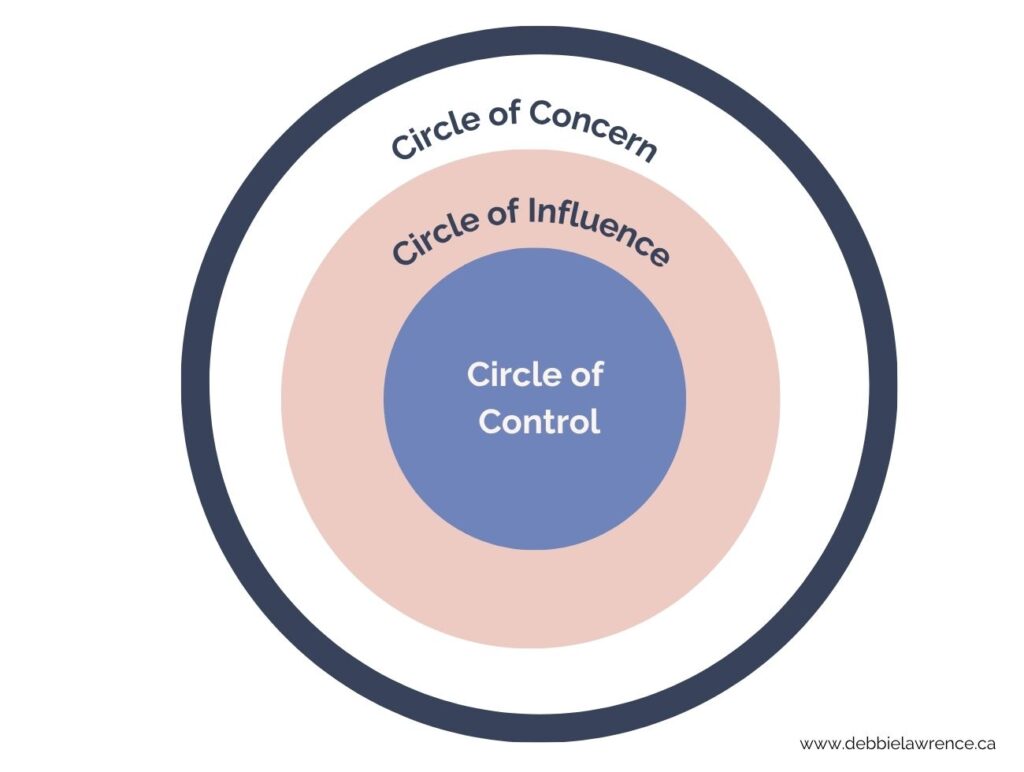
In the spirit of Epictetus’ teachings, Stephen Covey built the practical version of what I’m about to share into Habit 1 of The 7 Habits of Highly Effective People. He gave us the Circle of Concern, which holds everything we care about, and the Circle of Influence, which holds the smaller set we can affect. Proactive people, he said, work on the inner one, and it grows. Reactive people pour themselves into the outer one, and their influence shrinks.
I’ve added a third circle in the middle, because there’s a real difference between the things that are impossible for you to move, those you can nudge, and what’s genuinely yours to decide. That distinction is where most of the relief lives.
Here’s the exercise I walked Juanita through. You need a big sheet of paper and no more than 15 minutes.
Draw a large circle with a medium circle inside and then a smaller circle inside the medium one. Label the outer one the Circle of Concern. Now write down every single thing you’re worried about in this situation inside that circle. Don’t just choose the tidy ones. Identify all of them, big and small including the things in your personal life as well as what might be happening in the world in general that are taking up space in your head.
Juanita sat quietly for five minutes and came up with more than 40.
Next, go back through and put a percentage beside each one based on how much influence you have here. For example, reviewing the training materials before they go out to your team is 100% in your hands. Tariffs being applied to your sector is 0%. Most things live somewhere in the middle, and the estimate doesn’t have to be precise. It has to be honest and your best estimate.
Now move to the middle circle. Label it the Circle of Influence, and move everything with 1% or more into it. Anything sitting at a true zero stays out in the Circle of Concern where it belongs.
Juanita’s 40-plus dropped to 24.
Then focus on the circle in the centre. That’s the Circle of Control. Only things you have at least 80% influence over get to come in.
Hers came to 10.
Ten. Out of more than 40 things she’d been carrying at 1 a.m. as though each one had equal weight and equal claim on her, she ended up with less than a quarter of them in her Circle of Control.
Then we made a plan from the inside out. The 10 got her best hours, her sharpest thinking, and a date beside each one. The middle circle got effort in proportion to the influence she had, which for some items was about 10%, so it got roughly that much of her. And the outer circle got named, acknowledged, and left alone.
What I do differently now
Awareness is not the same as feeding something. I still know a thing is happening out there, the way air conditioning is constantly running in the background but you don’t really notice it until someone points it out. What I don’t do anymore is hand my best two hours to something sitting only in my Circle of Concern, or to something in the Circle of Influence I can barely move.
When I notice I’m spun up about something, I stop and ask myself out loud: Debbie, where does this fall? Control, influence, or concern?
If it’s concern, I have to put it down. It’s not permanent, and I don’t do it with any pretence that I’ve made peace with it. It’s just down, for now, so my energy can go where it can do something.
I do this in my business and I do it in my personal life. It’s one of the most useful things I’ve ever learned.
It works with other people you’re supporting too. If you’ve got someone on your team who’s feeling overwhelmed, sit down with them, hand them a sheet of paper, and walk them through the same three circles. You’re giving them a coaching conversation and something they can see. And the more times they do it, the sooner they can run it without you.
Juanita’s version came out like this. Whether the company adopts the new system or not was never hers to own and carry. She’d been consulted and she’d offered her two cents’ worth. What was fully hers was how her team first heard about it, how she prepared them, what she did with the lessons from the last rollout, and who she went to bat for if things got hard later in the year.
That’s her real work. It was just buried under 30 things that were never hers to do.
Your turn
Take this exercise for a test run. Give it 15 minutes with a sheet of paper.
Draw the three circles. Write everything down. Put a percentage on each one. Move what earns its way to the two inner circles.
Then look at what’s left in the outer ring, and let it be the thing you’re aware of and no longer the thing you’re carrying.
Comment below and tell me: what showed up in your Circle of Concern that you’ve been treating like it was in your Circle of Control? I want to know what you find when you see it on paper.
I read and reply to every response. And I love hearing from you.

P.S. Most of the leaders I work with have plenty of capability. They’re just spending it in the wrong circle. Sorting that out is a lot of what we do in 1:1 coaching and inside The Clarity Cohort. If you’re exhausted by something you can’t move forward, let’s talk.
P.S.S. You can also listen to this issue on The Compassionate Leader School podcast episode, which drops the same day on Apple Podcasts, Spotify, and all major platforms. Click here to explore all the episodes.
