



Too Intense to Be Liked
Issue #25
By Debbie Lawrence
Read time: 8 minutes
For years, across different roles and different managers, I kept getting the same note. They didn’t use the same words every time, but the feedback was close enough that I started to sense it was coming before it was ever said aloud.
You’re a perfectionist. You’re intense. You’d go further if you loosened up a little.
I remember sitting with that last one the longest. Loosen up. It was stated as if the thing that was responsible for the stellar work I produced, the thing I was actually being paid for, was also the thing standing between me and being liked. Nobody ever told me to loosen up on the deliverables. It was just on myself and that distinction mattered a lot.
I did what a lot of us do with feedback like that. I believed it. I tried to soften. I second-guessed the intensity that had gotten me the results in the first place, because someone in a position to shape my career had told me, more than once, that it was a problem.
It wasn’t until later in my career that I realized I’d been handed something that only looked like feedback.
The pattern revealed
Fast forward several decades and what I clearly understand today is how that note I kept being given was never about my work. It was a personality judgment presented as performance feedback.
Run it through the test I now use on every piece of feedback I give or receive, and it fails on every count. It wasn’t direct and clear. Loosen up, be more likable, tone down the intensity. None of that told me what I was actually doing.
It wasn’t growth-oriented either, because it named a trait instead of a behaviour, and you can’t develop your way out of who you supposedly are. And it definitely wasn’t actionable. What specifically did they think I could do differently that would still get the same results? Nobody ever said what that was and I was supposed to just know.
I later learned there’s a name for the exact bind I was in: the competence-likability bias. This is a bias that speaks to how women are rarely allowed to be seen as both highly competent and warm. When a man is described as assertive, decisive, and exacting, these qualities result in him being labeled a strong leader. A woman carrying the same description is classically called difficult. If a woman softens up to be liked, she risks being read as less capable. If she stays sharp and gets outstanding results, she risks being read as cold. There is no version of full effort that doesn’t cost a woman something socially. I didn’t have the language for that at the time but I knew I was being asked to shrink the part of me that drove my ability to achieve great results.

The pattern I see everywhere
I hear versions of my own story constantly, from female clients who are sharp, capable, and quietly convinced there’s something wrong with their personality rather than understanding what’s missing is something in the quality of the feedback they’ve been given.
There’s data behind this now, and it’s worth digging into. Textio’s 2024 research, pulled from over 23,000 performance reviews (80% from North America and 20% from other parts of the world) plus a 450-person survey, found that women get feedback about their personality rather than their work 22% more often than men. The part that stopped me when I read it is how that gap doesn’t shrink for high performers. It’s identical whether you’re looking at the top, middle, or bottom of the performance curve. As the report puts it, not even being the highest performer exempts a woman from paying the “personality tax.”
And being excellent doesn’t buy you better quality feedback. If anything, it buys you worse. High performers get 1.5 times more feedback overall, which sounds great until you look at what’s in it. They get 1.8 times more exaggerated feedback. They hear words like “always” and “never”, and 2.6 times more fixed-mindset feedback, the “she’s just brilliant” or “she’s a natural” language that tells you nothing about what you did and everything about how you’re being categorized.
Women are eleven times more likely than men to be called abrasive. Nearly 80% of women recall being called emotional in a way that was meant as criticism, which brought me back to my own “you’re too intense” and “you’re such a perfectionist” feedback. And when the label is a backhanded compliment instead of a criticism, women fare no better: they’re twice as likely as men to be called an “overachiever,” a word that quietly means you cleared a bar that was never set very high for you.
The finding I want you to sit with the longest is the one about who’s handing this out. It isn’t only men. Kieran Snyder, the researcher behind this work, discovered the same pattern back in 2014 and it’s held for a decade: when women manage women, the bias shows up exactly the same as when men manage women. She’s said that after she first found this, she went back through her own old written feedback to people who’d reported to her, and didn’t love what she read in her own words. That’s the part that matters most here. This isn’t a problem you route around by finding a female boss. It’s a habit of language, and every one of us, myself included, is carrying some version of it until we deliberately interrupt it and remain vigilant about checking for it.
The distinction
Once I understood what had happened to me, I got serious about never doing it to anyone else. Over the years of teaching and coaching, I built a checklist I now run every piece of feedback through before it leaves my mouth or my keyboard.
For starters, it has to be growth-oriented, which means it names a behaviour, not a trait. It has to be clear and direct, so there’s no “I feel like” or “in my opinion” doing the work that a plain statement should be doing. It has to be relevant, meaning it’s tied to their job, not to who someone is when they’re not doing the job. It has to be actionable, which means it comes with a real example and a real alternative, not just a verdict. And it has to point at the right kind of action, telling the person exactly what you want more of or less of.
When I later read Textio’s own research, I sat up straighter. They’d landed on nearly the same five checkpoints, growth-oriented, direct, relevant, actionable, clear, and they’d gotten there from 23,000 performance reviews instead of one career’s worth of frustration. I hadn’t built my checklist to match theirs. I built mine from the inside of getting it wrong, over and over, and hearing my clients get it wrong too. When two people arrive at the same list from opposite directions, data on one side and lived experience on the other, that’s worth leaning into and applying.
An example of testing it for real was with my client Sharon. She’d hired her first two employees a year earlier and was staring down her very first performance reviews, wanting so much to get it right. She reached out to me because she wanted to be fair, and she genuinely didn’t know what fair looked like on paper or in how to talk to her employees about their performance.
I worked with her on her first draft and here’s a sampling of how we up-leveled the quality of performance feedback she offered:
- “You’re dropping the ball” became “About half of the weekly client updates went out late or not at all in Q3.”
- “You’re just naturally good with people” became “You kept two of our biggest accounts from leaving when pricing changed in June.”
- “You need to be more proactive” became “When the July shipment was delayed, I only found out when the client called me directly. Next time, I want to hear it from you the same day it happens.”
- “I feel like you could communicate better with me” became “Given you’re still in a steep learning curve, I need to be looped in before any client decisions are finalized, even small ones. That can be done via email or a scheduled meeting to talk it through. You choose the medium.”
Each rewrite took something Sharon felt about her employee and turned it into something her employee could do differently right away. That’s the whole test, the same one I run on my own feedback. Could the person walk away and understand what they need to do differently because of what you said, or did you just make them feel something (more often than not that something is confused or unsure) and call it done?
What I do differently now
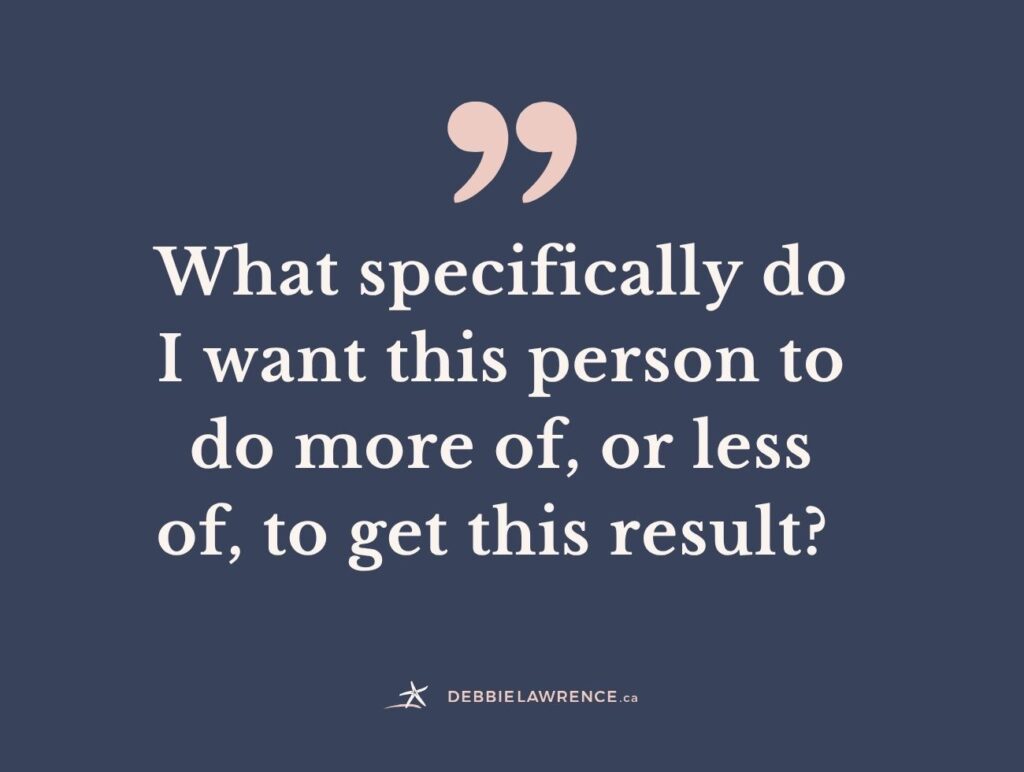
Before I give feedback, I ask myself the question nobody asked me for most of my career: what specifically do I want this person to do more of, or less of, to get this result? If I can’t answer that in one plain sentence, I know I’m not ready to give the feedback yet.
I’ve also stopped letting “intense” or “a lot” or “too strong” pass my lips as feedback at all. Those words tell someone how I feel about them but they don’t tell them anything they can use. If what I actually mean is that someone interrupts people in meetings, or pushes back before hearing the full plan, I say that, specifically, with an example, and I say what I’d rather see instead.
And when I catch myself softening my own edges to be more palatable and to avoid taking full ownership of the feedback I’m offering, which still happens, I ask myself this question: am I about to shrink to make both of us feel more comfortable in the moment but where they walk away wondering what point I was trying to make, or am I dealing with this performance problem clearly and directly?
Your turn
This week, your take action challenge is to find one piece of feedback you gave (or received) recently that named a trait instead of a behaviour. Perfectionist. Intense. Overachiever. Ambitious. A lot. Too much.
Run it through the checklist: is it clear and direct, growth-oriented, relevant, actionable, and does it say what you want more or less of? If it fails, rewrite it with one specific example and one specific ask.
Comment below and tell me what you chose and how you reframed it. I’d love to know.

P.S. You can also listen to this issue on The Compassionate Leader School podcast episode, which drops the same day on Apple Podcasts, Spotify, and all major platforms. Click here to explore all the episodes.
