



Are You Building a Close-Knit Family or a High-Performing Team? Here’s Why You Can’t Have Both.
Issue #18
By Debbie Lawrence
Read Time: 8 minutes
A few issues back, I told you why “we’re like a family here” is one of the most dangerous phrases in leadership. Today I want to show you what it actually costs, not emotionally, but operationally in the day-to-day mechanics of running a team.
Let me tell you about my client Marilyn.
Marilyn ran a cleaning services company for residential and commercial clients. She had a small and tight-knit team of eight. Her very first employee was a close friend. A couple of others came from people in her personal circle. She didn’t set out specifically to hire people she knew but it just evolved that way, the way these things so often do, especially when you first start a business.
As a leader, Marilyn wanted everyone to feel like they belonged and like they were cared for. That’s both admirable and understandable. It’s also, if you’re not careful, exactly how you end up building something you can’t unwind.
Here’s what I mean. There’s a difference between being friends and being friendly with your team members when you’re the person to whom they report. When that line disappears, when you’re promoting the idea that your team should function like a family, it feels good, especially early on. It creates the sense that you’re building loyalty. But it also comes with a cost you don’t typically see until later.
Marilyn talked about one of her team member who had been with her almost from the beginning. She knew everything about that person’s life — the financial challenges at home, the things going on with their kids. She had another team member managing an ongoing health issue. She was all up in their business, as she put it to me. And because of that, she found it nearly impossible to lead them.
To add to this situation, Marilyn was also having performance issues with these employees. Clients complained of cleaning standards that were not being met. One of the employees chronically missed shifts or asked for shifts to be changed because she was dealing with issues outside of work. There always seemed to be something and Marilyn had been reluctant to address them directly, especially when these same team members thanked her for being such a good boss and a good friend, and for being so understanding.
Predictably, other team members noticed. They were frustrated that the performance issues weren’t being addressed. And when a client’s home needed to be cleaned and the unreliable team member couldn’t fill the shift, it wasn’t that person who absorbed the consequence. It was the dependable ones who Marilyn asked, again, to make an exception and extend their shift so the gap would be covered.
Meanwhile Marilyn herself was picking up jobs just to get them done, which meant she couldn’t get to the fundamental work of running her business.
By the time she came to me, she was exhausted, frustrated, and sitting inside something she felt she’d built and could no longer take apart.

The pattern you can’t see until you do
Here’s how it happens, step by step, and I want you to notice if you recognize yourself anywhere in it.
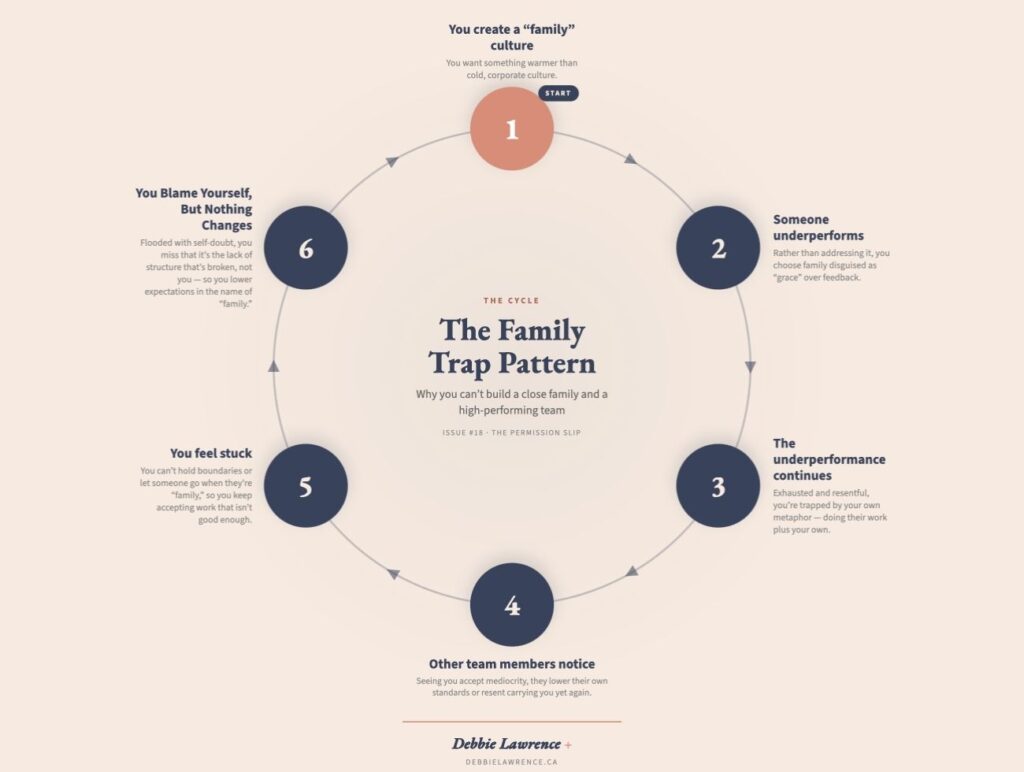
You create a “family” culture because you want to be different. You’ve worked inside cold, corporate environments and hated it. What you wanted instead was something warmer, more human. So you tell your team, “we’re not like other companies, we’re a family here.” Everyone loves it. You feel good, because this is the culture you set out to build.
Eventually someone underperforms, and you have a choice. Do you address it directly, the way you would in a professional relationship? Or do you let it slide, the way you would with family? You choose family, because that’s what you said you were. “They’re going through something. They’ll bounce back. I’ll give them grace,” you hear yourself say when you’re discussing this dilemma with a close friend.
As a result, the underperformance continues and now you’re doing their work and yours. You’re exhausted and resentful, but you can’t say anything, because we’re family, and family doesn’t give up on each other. You’ve trapped yourself inside your own metaphor.
Your other team members notice just as they did in Marilyn’s situation. The ones who are reliable watch you accept less from someone else, and something in them recalibrates. Some lower their own standard believing that if that’s good enough for her, maybe I don’t need to try so hard either. Others just get quietly resentful because they’re carrying the extra weight and nothing’s being done about it.
As for you, you feel stuck. You can’t fire someone from a family any more than you can hold a firm boundary with family. Instead you keep absorbing work that isn’t good enough, and you keep resenting the situation you built.
You blame yourself. You start doubting yourself. Maybe I’m not good at managing people. Maybe I’m too demanding. Maybe I need to lower my expectations. What you don’t see is that the problem was never you. It was the family structure you created and you cannot run a high-performing team on family rules, because family rules optimize for belonging while business rules have to optimize for results.
What you’re actually building
Here’s the thing worth sitting with: in business you can’t actually build a family. Family is something you’re born into, adopted into, or marry into. It is not something that comes into being because of an employment contract, no matter how much warmth you bring to it.
I want to come back to something I referenced in issue five where I talked about the family framing approach in a workplace. There is a profound difference between a culture that feels like family and a culture you are trying to build into a family.
The first one is something that happens organically when you lead well. It‘s when some of your team members describe their workplace as being “like a family.” That is a beautiful outcome. It is not a management strategy. It is the result of one.
What I’m talking about here is where you are actively promoting the family premise, setting the expectation of family by reaching for the family framing. The problem is that, without realizing it, you create a kind of guilt-based compliance that cannot sustain itself and puts your team members in an impossible position: feeling like there might be something wrong with them because they don’t feel what they’re being told they should feel.
On top of that unknowingly you set in motion expectations from your team members about how you should lead because you have been encouraging the family premise.
Think about what you are building, whether you mean to or not. It’s going to be one of two models.
Model A: A high-performing team that has clear roles, explicit standards, and consistent follow-through on both. Membership is conditional on contribution and people can leave or be asked to leave without it registering as a personal wound.
Model B: A dysfunctional pseudo-family that has roles that shift based on whoever’s willing to pick up the slack. Standards go unstated, so people disappoint you and others without ever being told why. Accountability gets avoided because it feels too close to rejection. And leaving, or being let go, lands as betrayal instead of a change because the person or the role is no longer the right fit.
You cannot split the difference between these. There’s no version of “high performance with family vibes,” because high performance requires boundaries and standards, and family vibes make those things feel unkind.
What actually changes when you shift from family to team
Teams exist to accomplish something together where the mission is the point, not the relationship itself. When someone isn’t contributing, it stops being personal and becomes structural. The question isn’t “do they belong here?” It’s “can they contribute to what we’re building?”
Teams have defined roles instead of “we all just pitch in.” You stop doing everyone’s job, because everyone knows what they own including you.
Teams have a real answer to “what does great look like.” So when the work misses the mark, you can name the gap directly: here’s the standard, here’s where this landed, here’s what needs to change. It’s not communicated as an accusation but as information.
And teams are designed to change. People join, people leave, and the team continues because what holds it together is shared purpose, not forced closeness.
What this sounds like in practice
When you apply this to a real workplace situation where, for example, someone misses a deadline, it sounds different under the family model versus the team model.
Under the family model, the instinct is to default to: they’re going through a lot right now. I don’t want to add to it so I’ll just do it myself and gently mention it later, if I remember. The deliverable gets done late, usually by you, and the pattern repeats because nothing was actually said.
Under the team model, it sounds more like this: “The deliverable was due yesterday and it wasn’t completed. I understand there’s a lot going on for you right now. What I need is for deadlines to be met, or for there to be a heads-up in advance if one can’t be. If your workload needs a temporary adjustment while you handle what’s going on, let’s talk about that but we can’t have surprise misses.” The issue gets addressed, support is on the table if it’s needed and the pattern breaks (or gets repaired), instead of quietly continuing.
This is coaching for performance, not punishment. It’s possible to hold someone to a standard and still care about what they’re carrying. Those aren’t in conflict. They only feel like they are when the whole relationship has been built on the premise that closeness and accountability can’t coexist.
Your turn
This week, look at one place on your team where you’ve been operating on family rules instead of team rules. Maybe it’s a standard you haven’t enforced because you didn’t want to be “that” leader. Maybe it’s a role that’s gone undefined because naming it directly felt too corporate for the culture you were trying to build.
You don’t have to overhaul everything this week. Just name where it’s happening.
Comment below and tell me: is there someone on your team you’ve been leading like family instead of like a teammate? What would it look like to shift that, even slightly?
I read and reply to every response. And I love hearing from you.

P.S. You can also listen to this issue on The Compassionate Leader School podcast episode, which drops the same day on Apple Podcasts, Spotify, and all major platforms. Click here to explore all the episodes.
