



Effort ≠ Results
Issue #19
By Debbie Lawrence
Read Time: 9 minutes
This past week I had a conversation with a client about how rewarding effort instead of results feels kind in the moment and becomes expensive over time. I shared with her about how early in my career I had a particular hire where this became evident but only in hindsight. Let me tell you about Nathan.
He was the new hire the president couldn’t stop talking about. Nathan looked great on paper. He was connected in the business community, had relevant experience, and outperformed everyone else in the job interview. He brought good energy into a room and was the kind of hire everyone’s excited about before they’ve actually seen the work.
As the person responsible for operations, I spent time with him day to day, developing and delivering on projects for our clients, and within a few weeks I could see something the president couldn’t from his office down the hall.
Nathan tried. He looked busy. He talked, at length, about what he understood the end goal to be and what he wanted to build. The problem was he wasn’t creating anything concrete, not even a draft we could work through, and by the end of the first three months, there wasn’t a single deliverable we could present to a client.
By week three, I told myself he was ramping up. Week eight, I told myself he needed more time. By month three, I was rebuilding his plans myself two days before milestone meetings and calling it “smoothing over a rough patch.”
I raised it from time to time with the president, suggesting he may not be the right fit. “He’s trying so hard,” he said. “Be patient. Give him room and time to grow into his new role.”
So I gave him room. For an entire year.
Every few weeks I’d sit down with Nathan and name exactly what the plan needed. There were dates that had to coincide with what we had promised in the statement of work, deliverables tied to a named owner (mostly Nathan), and an end product the client could implement without calling me to translate and support it. He’d nod in agreement with all of it. I would reinforce with Nathan how I could see that he was trying, as if trying was the only result he needed to produce. He’d smile and say, “Thanks for the encouragement.”
Then a few days later another draft would land, and the same gaps would be sitting right there again. Exasperated, I started filling in those gaps and handing it back to him to pick up from there recognizing that if I didn’t, we’d never meet any of the deadlines. For months we did this dance.
The president pulled me aside one afternoon following a meeting with the three of us. “Debbie, your standards are too high. You’re expecting too much, too soon.” I was young in the role, and not yet confident enough to trust my own read over the president’s so I quieted the doubt instead of the standard, and kept fixing Nathan’s work myself instead of sending it back. And all along I rationalized that we had to take care of the client and I believed I had to do it at all costs.
It took a full year before the president and I agreed the role wasn’t working. That grew into a year of me doing two jobs. It was a year where the client work still shipped, because I made sure of it, and a year where the role itself made no real progress beyond what I was able to push out.
Looking back I can see that the ask was never too much. If anything it was specific, and yet Nathan couldn’t deliver on it. Every time I rewarded the effort instead of naming the gap, I taught him the wrong lesson and paid for it myself.
That’s the trade a lot of leaders end up making without noticing. Effort is visible. It’s right there in front of you: the extra hours, the enthusiasm, the updates on what someone’s working on, and the empty promises of delivery. That is exactly what I experienced with Nathan.
Results take longer to show up, and sometimes they don’t show up at all. In their absence you praise the thing you can see by giving feedback like “I can see how much work you’ve put into this. Great job.” Without meaning to, you teach the lesson that trying hard is the finish line, not the starting point.
The pattern I’ve seen for years
Over the years of coaching and teaching I’ve heard a number of versions of Nathan’s story. Someone on the team is putting in real hours and they talk a lot about the work but the actual deliverable still isn’t there. And the leader has a reason to let it slide that sounds completely reasonable in the moment.
Let’s start with “They’re trying so hard.” Yes, effort matters but your business isn’t a participation trophy program. Praising the effort instead of naming the gap teaches one lesson, which is that trying hard is enough, no matter what gets delivered.
Another variation on this theme is “I don’t want to discourage them.” This one sounds like kindness. The quieter message underneath it is: I don’t think you can meet this standard, so I’ll lower it for you instead of telling you the truth. While the leader thinks they’re offering protection, it’s just a delay on when the disappointment finally lands.
“It’s faster if I just do it myself” is another version. Today, that’s true because taking ten minutes to fix it beats thirty minutes explaining what’s wrong and waiting for a redo. But that math only holds if you ignore every future occurrence, and there will be dozens. Ten minutes, twenty times a month, is 200 minutes you didn’t have to spend if you’d taught the standard once.
One more version is “Maybe I’m being too picky.” This is the one that kept me quiet with Nathan for a year. Someone questions your standard, and instead of asking whether the standard is necessary for the role, you start wondering if you’re the problem. The feedback I received about not being patient enough and my standards being too high is straight from the pages of the broken playbook that I talk about so much. What I didn’t see then and what I want you to see now is that your standard doesn’t become negotiable just because someone is struggling to meet it.
All four versions sounded reasonable when I said them to myself all those years ago. All four cost me a year.
Fair isn’t the same as nice
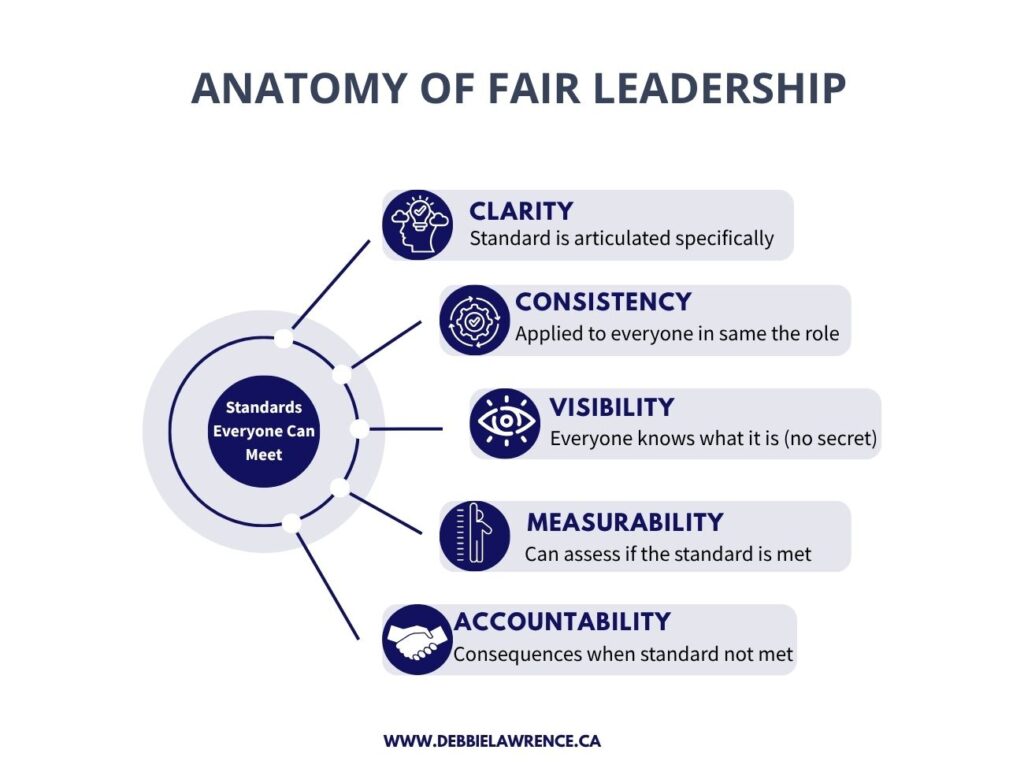
The distinction I eventually learned, mostly by getting it wrong first, is that fairness runs on clarity, not on niceness. Plus its anatomy consists of four additional elements that work together to provide the depth of support required. Miss even one, and it collapses no matter how good your intentions are.
Here is the anatomy of fair leadership:
- Clarity: Make sure the standard is specific, not implied. Vaguely communicated sounds like “the final version has to be client-ready.” Clearly communicated sounds like “make sure the final version has no typos, matches our template, and is signed off by your supervisor before it goes out.”
- Consistency: This means the standard applies to everyone in the role so you don’t accept typos from one person and expect flawless work from another. You need to pick one standard for the role, not for the person.
- Visibility: In this case, the standard is named upfront and out loud, rather than something you’re privately measuring people against and never telling them.
- Measurability: In the words of Peter Drucker, “what gets measured gets managed.” Measurability focuses on how you will know quantitatively whether the standard got met. Vagueness sounds like “deliver good customer service.” When it’s quantifiable the team knows that if they respond within 24 hours, resolve or escalate any issues by adhering to specific steps, and the customer’s satisfaction is confirmed by the rating they provide on a follow-up survey question, it takes the ambiguity away and provides specific measurement.
- Accountability: This is where when the standard isn’t met, something happens in a timely manner whether it’s a conversation, an accommodation, or a deadline that must be met. Eventually, it could even look like placing that person in a different role or exiting them, especially if it keeps not happening.
Looking back, I had clarity with Nathan, mostly. I had a real standard in my head. The piece I was missing was accountability. I kept naming the gap, then absorbing it myself instead of letting the consequence land where it should. Ironically, Nathan never experienced what happened when a plan wasn’t ready, because I made sure a finished one existed by morning regardless; and the feedback he received was a celebration of his effort, not his results.
What I do differently now
After that experience, I started to see that if the work didn’t meet the standard, it went back to the person who owned it, with the gap named specifically and a deadline attached. I wish I could say I stopped fixing it myself but that still took a couple of years for my actions to align with what I believed.
Once I got crystal clear though, the first few times felt uncomfortable in a way I wasn’t ready for. I worried I sounded harsh. I wondered, again, if my standard was unreasonable. That’s when I learned to embrace getting comfortable with feeling uncomfortable. I also had to acknowledge that deconditioning myself from the broken playbook would be a bit of a process.
With time what started to happen was that the work from my team got better, faster than a year of quiet fixing ever managed. People started asking clarifying questions upfront instead of guessing, because they knew guessing wrong meant redoing it.
Today, I name the standard before the work starts, specifically, and out loud. I send work back the first time it misses, not the tenth. I set a real deadline for the revision and don’t quietly do it myself while I wait. And I don’t apologize for having a standard anymore. I say “this needs to change,” and I get specific about why and what.
I learned from experience working through it how the cost of rewarding effort instead of naming the gap and only settling for great (a.k.a. specific results aligned with this role) is always higher than the discomfort of naming it.
Your turn
This week, hold the line once.
Think about someone whose work you’ve been quietly fixing, adjusting, or finishing yourself. Compare what they submitted to the standard you need, not the one you’ve been settling for.
Send it back and name specifically what needs to change. Set a deadline and don’t touch it yourself while you wait.
Believe me when I say you’ll want to fix it. Just notice that urge, and don’t act on it.
Comment below and tell me: where have you been rewarding effort when you actually needed results? I want to hear what you notice once you name it.
I read and reply to every response. And I love hearing from you.

P.S. This exact pattern, effort dressed up as a reason to lower your standard, is one of the fastest ways I help clients find what’s broken in a team, in 1:1 coaching and inside The Clarity Cohort. If you’re a year or more into your own version of the Nathan story right now and you already suspect what I’d tell you, let’s talk before it slips into another year.
P.S.S. You can also listen to this issue on The Compassionate Leader School podcast episode, which drops the same day on Apple Podcasts, Spotify, and all major platforms. Click here to explore all the episodes.
