



The Promotion That Exposed a Blind Spot
Issue #20
By Debbie Lawrence
Read Time: 7 minutes
Carolyn couldn’t believe her decision to reward great work could end up like this. Her situation is a familiar one. Like many others it started the same way. Someone earned a promotion because they were excellent at their old job and what followed was a situation the leader didn’t see coming. That’s exactly what happened to Carolyn and why she reached out to me for leadership coaching.
Carolyn runs a non-profit. Her Projects & Events Manager, Danny, had been in that role for five years and excelled at everything he did. During that time one of his most successful working partnerships was with Glenda. Together they ran the best events the organization had ever hosted. Danny had the vision and Glenda made sure every detail landed. When Danny left for a new opportunity, Carolyn posted the role internally first. Glenda applied, interviewed well against the other internal candidates, and Carolyn offered her the job.
The first two months looked good. When Glenda met with Carolyn, she’d mention how grateful she was that Danny had left such thorough files on every event. Carolyn took that as a sign Glenda was settling in.
By month three, cracks were starting to show. Glenda would nail something on one aspect of a project and freeze on another. Carolyn chalked it up to newness. Glenda was in a new role with new expectations and it was important to give her room to feel her way through.
Then Carolyn handed her a project the organization had never run before. This time there was no file to inherit or established process to follow. It landed as just a blank page and a deadline.
Four months later, that project was eating half of Glenda’s time and going nowhere. For the first time she was displaying a decline in her confidence and belief in her own abilities; and other employees who were impacted by the lack of progress on the project were quietly sharing their concerns and frustrations. In addition, the deadline for the completion of the project was approaching and there were commitments that had to be met to satisfy the main funder as well as the board of directors
There was nothing lazy or incompetent about Glenda. Every tactical piece of her old job was still being done well. Carolyn also noticed that Glenda was reluctant to delegate the tasks that she had done for Danny that should now be taken care of by the person who stepped into her former position. On top of that, when asked to build something from nothing, she froze, asked for reassurance on every decision, and quietly avoided anything that didn’t come with a template already attached.
Carolyn couldn’t square it. The same person who’d been a superstar for five years was suddenly struggling to function. What she hadn’t seen yet was that while Glenda had been brilliant at executing Danny’s vision, she had never once been asked to build her own.

The pattern revealed
When I met with Carolyn, her first question to me was whether I thought she had misread Glenda all along and ended up promoting a bad hire. That was definitely not the case. What Carolyn came to see was that she’d promoted her best tactician into a strategist’s seat, and assumed excellence in one meant readiness for the other.
I hear a version of Carolyn’s story from a lot of the leaders I coach, usually a few months after the promotion of a team member or when there’s been a new hire and right when the frustration sets in. When I ask them to tell me about what kept them from taking action up to this point, here are some of the more common responses:
“She’s my best person so I believed she was ready.” This one feels obvious in the moment. Skill is visible, and it’s tempting to believe skill is skill. But carrying out tasks brilliantly versus designing the work from scratch that identifies what tasks need to be carried out are two different jobs wearing the same job title.
“She’ll grow into it.” Sometimes that’s true. Often it’s just a delay tactic dressed up as patience, while the real gap goes unnamed and the team absorbs the cost of someone flailing in a role built for a different kind of thinking.
“No one else even applied.” This is the scarcity trap. When the candidate pool is one person deep, leaders talk themselves into treating “available” as “qualified.” The role doesn’t get any less strategic just because the search was short.
“It feels risky to look outside.” Promoting from within is loyal and comfortable. It also means the assessment often stops at “have they been great here” instead of “do they think the way this new role requires.”
“They’re smart, they’ll figure it out.” This one is similar to “she’ll grow into it” but here’s the nuance. Intelligence and skillset aren’t the same thing. A brilliant tactician can be sharp, well-read, and quick on their feet, and still freeze the first time no one hands them a process to follow. Being capable in general doesn’t mean being capable of the specific kind of thinking where you are developing systems and processes, identifying patterns, and creating clarity from complex circumstances.
Every one of these reasons sounds sensible when you’re standing inside it. The cost shows up later. When the best tactician you had is now a struggling manager, the role that needed a builder has a person waiting for direction on what and how to build, and the whole team feels the drag.
The difference between tacticians and strategists
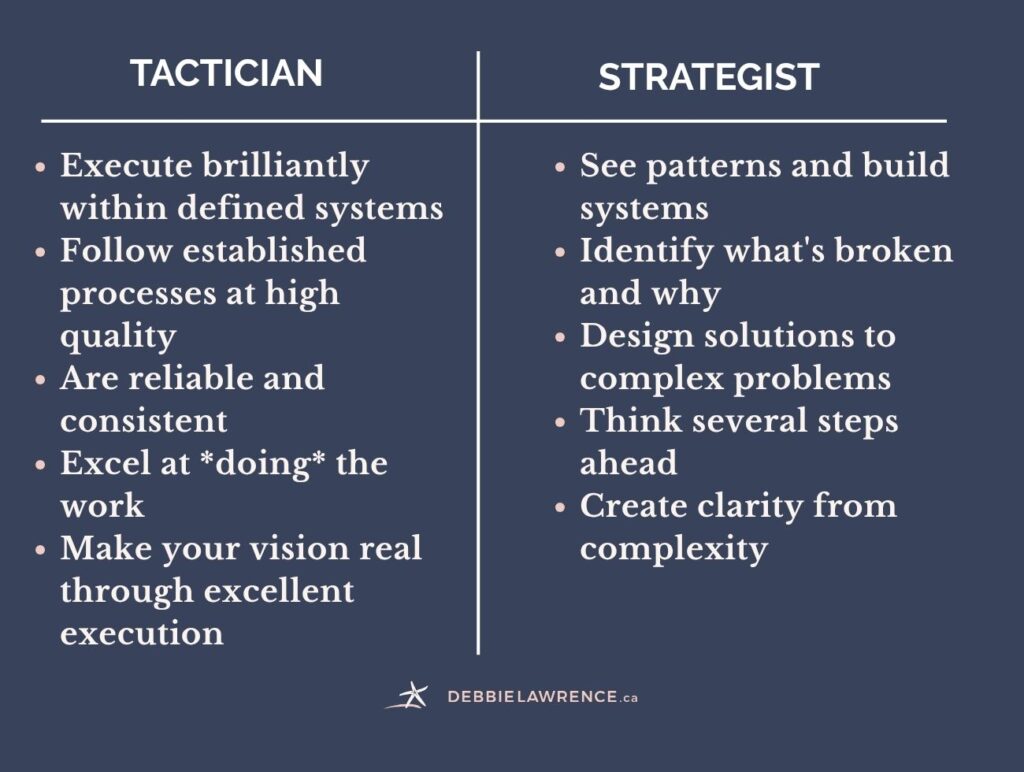
Tacticians answer one question well: how do I do this excellently? They execute inside a system someone else designed, and they do it with consistency you can set your watch to.
Strategists answer a different question: what should we be doing, how should this work, and how can it be optimized? They’re the ones comfortable staring at a blank page, diagnosing what’s broken, and building the system everyone else will later execute.
Danny was a strategist. He built the events program from nothing and left behind files so complete that Glenda could run them without ever having to think strategically herself. Glenda was the tactician who made Danny’s vision real. Ask either of them “what’s broken here?” and you’d get two completely different answers. Danny would name a root cause. Glenda would ask what you wanted her to do about it.
Neither is a lesser skillset but they’re not interchangeable. And promoting someone from one into the other without checking which kind of thinking the new role actually needs is how you lose your best tactician and gain a manager who’s struggling; and vice versa where you can deflate your strategist by only assigning them tactical work.
Every so often you’ll find someone who genuinely has both. Watch closely though, and it’s rarely an even split. What you actually have is a strategist who is willing to get their hands into the tactical work long enough to build the first version and work out where it breaks, before handing it off to a tactician to run at scale. They’re not doing tactical work because that’s who they are at their core. They’re doing it because a new idea needs someone to pressure-test it before it’s ready for someone else to execute. Mistake that person for a tactician, or expect them to stay in the weeds once the thing is built, and you’ll lose them the same way you’d lose any strategist parked in the wrong seat too long.
Getting the right person in the right role
Before I recommend anyone move into a role that requires building something new, I test for it first. I give them an undefined problem, something with no existing process, and I watch what they do with it. Do they ask me what to do, or do they start proposing approaches? Do they describe each situation on its own, or do they connect the pattern across all of them?
If the answer says tactician and the role needs a strategist, I say that plainly, to the person and to the leader considering the move. It’s important not to see this as a verdict on the team member’s worth but as a fact about fit. “You execute better than almost anyone I’ve seen. This role needs someone to design the thing you’d be executing, and that’s a different skill.” Then we talk about whether they are wired to build that skill, or whether there’s a role that better fits who they are including the one they’re already occupying.
That conversation is uncomfortable and absolutely necessary to have before the promotion. But I promise you it’s a lot more uncomfortable to have a year in, after they’ve struggled publicly and started to doubt themselves for reasons that were never about their character. That’s the very situation Carolyn and Glenda found themselves in.
I also stopped treating “great at their current job” as the main qualifier for any role that requires building something new. Now it’s one data point among several. I ask what they’ve done when nothing was defined for them yet, not just what they’ve done inside a system someone else built. If the answer is nothing, that’s important information. It may not be a disqualifier, but it tells me exactly what to test for before I hand them the keys to this new role.
Your turn
This week, look at one person you promoted, or you’re about to promote, into a role that requires building something new.
Give them one undefined problem, something with no template attached, and watch what they do with it. Do they wait for direction, or do they start proposing a path forward?
That’s your answer. Act on it before the drag sets in, not after.
Comment below and tell me: who have you promoted for the wrong skillset, and what did it cost you before you saw it? I want to hear what you notice once you name it.
I read every response and I love hearing from you.

P.S. I want to leave you with this one core belief to reflect on: as a woman who leads, I can work less and grow no matter what my team looks like.
P.S.S. This exact mismatch, tactical excellence mistaken for strategic readiness, is one of the fastest things I diagnose with clients, in 1:1 coaching and inside The Clarity Cohort. If you’re watching your best hire struggle in a role you moved them into, let’s talk before the whole team feels the drag.
P.S.S.S. You can also listen to this issue on The Compassionate Leader School podcast episode, which drops the same day on Apple Podcasts, Spotify, and all major platforms. Click here to explore all the episodes.
