



Vagueness is Mean
Issue 11
By Debbie Lawrence
Read Time: 9 minutes
Rachel
Rachel was at her desk at the end of a long Thursday, staring at a report from Meaghan that was three days late and clearly rushed. There were errors. One major section was missing entirely.
She knew what she needed to do.
She also knew she didn’t want to do it.
This had been building for weeks. The missed deadlines. The thin answers when the project came up in meetings. And the two conversations Rachel had already tried to have: once after a meeting, quietly, off to the side, and once framed as a general check-in so it wouldn’t feel too pointed. Both times Meaghan had nodded. Both times Rachel had walked away feeling like she’d done the hard thing.
She hadn’t done the hard thing. She’d talked around it.
I’ve said this. I’ve been consistent about this. Why isn’t it landing?
What Rachel didn’t see was that Meaghan had been reading the situation accurately. The first conversation felt serious. The second felt optional. By the third, Meaghan had wondered, without anyone saying it out loud, if this was going anywhere and wasn’t sure if there were any consequences for her to be too concerned about.
Each time Rachel came back, she’d come in quieter and danced wider around the core issue. She was trying so hard not to be the kind of leader who makes people feel bad that she’d become the kind of leader who made Meaghan feel unsure and confused.
Rachel told herself she was being patient. What she was actually doing was managing her own discomfort, and Meaghan was learning that the expectations around her work were open to interpretation.
Rachel had been consistent. The problem was that she’d been consistently unclear.
She’d been delivering the same message with diminishing clarity, waiting for Meaghan to suddenly respond differently. It was landing as a monologue and that’s a very organized way of hoping.

When clarity is called kindness
Here’s the thing about a monologue: it’s a one-way delivery. You can say it clearly, say it repeatedly, say it with real care. And it can still land with almost no impact if nothing is happening on the other side.
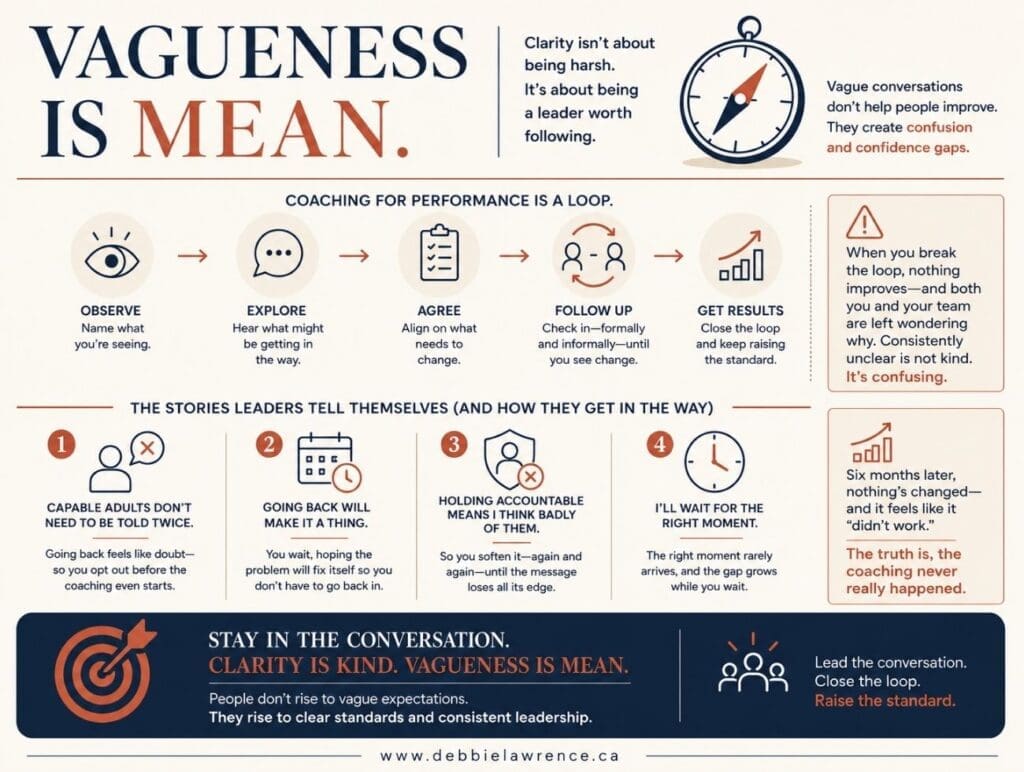
Coaching for performance is a loop. You name what you’re observing. You make room to hear what’s in the way. You agree on what changes. You follow up, formally and informally, until you can see whether something has shifted in the right direction. When the loop stays open, things move forward. When it closes before it should, you’re left wondering why nothing changed, when the answer is that you never found out what was actually happening in the first place.
I see women who lead get stuck in this pattern, and underneath almost all of it is the same fear: being seen as mean. As unreasonable. As demanding. As the kind of woman who makes it hard to work for her.
That fear didn’t arrive without help. Women who lead have been handed a playbook that says be flexible, be approachable, don’t be too demanding. Nowhere in that playbook is there a chapter on how to hold someone accountable without apologizing for the conversation.
So the reflex kicks in. Soften it. Overexplain it. Make sure she knows you still believe in her before, during, and after the thing you came to say. And in all that softening, the actual message gets lost.
She reaches for softness and calls it kindness. The person on the other side experiences uncertainty and confusion. And that vagueness is mean.
The stories she tells herself to justify the softening almost always sound like one of these.
The first story: capable adults don’t need to be told twice. Going back in feels like doubt, like implying the other person didn’t hear her the first time. There’s a version of respect in this belief but there’s also a way it lets the leader opt out before the coaching has even started.
The second story: going back will make it a thing. Formal. Documented. Something that could lead somewhere uncomfortable. So she waits, watching, hoping the problem resolves on its own so she doesn’t have to go back in.
The third story is the quietest one. Somewhere, she absorbed the idea that holding someone accountable means she’s decided something bad about them. So each time she returns to the conversation, she softens it a little more. She’s less direct. More hedged. Until the message has so many edges sanded off that the person on the other side genuinely doesn’t understand the stakes.
And then there’s a fourth story, the one she doesn’t always name out loud: she’s waiting for the right moment. She tells herself she’ll go back in when things settle down, when the pressure lifts, when she has time to do it properly.
But the right moment doesn’t arrive. The gap grows while she waits for conditions that never quite materialize.
Six months in, she hasn’t coached this person. She’s accumulated quiet evidence that it “didn’t work.” What she hasn’t examined is the part her approach played in getting them to this place.
What staying in the conversation looks like
I know what it looks like when it works, because I’ve had to do it.
Years ago, I was VP of a franchised organization. One of my senior team members (I’ll call her Lily) had been assigned to develop a project including a comprehensive project plan with milestones, a timeline and specific deliverables. It was bigger than anything she’d managed before, and it was a new project for our franchisee network.
The signals were quiet but they were there. She missed the first two deadlines and offered thin answers when the project came up in meetings. Lily also offered rationale that didn’t hold up when I asked questions.
I could see something was in the way. What I didn’t do was assume I knew what it was or that it would just go away with time.
Instead, I sat with Lily and told her what I was observing. Not what I thought it meant. Just what I was seeing: the missed deadlines, the gaps in the work, the moments in meetings where she seemed to be reaching for answers she didn’t have. I entered into that discussion with curiosity and shared these observations without judgment and without a verdict. My only agenda was to understand what was happening.
I didn’t just magically know how to do this. I’d had interactions with team members that did not go well: feedback that landed flat, or was so vague the person walked away more confused than when they came in, or was so blunt it couldn’t be heard. I had to figure out how to do this on my own, through trial and error. I want something different for you.
Back in that meeting with Lily, that’s when she finally told me she was stuck.
Here’s what I’ve come to believe about these conversations: most of the time, both people want to have the real one.
Lily knew something was off. She’d been feeling it for weeks. In the absence of a direct conversation, she’d been standing in the fog of it, filling the silence with her own interpretation of what was wrong. When I told her what I was seeing, without judgment and without a verdict, I gave her something specific to work with instead of a vague cloud to stand in.
She didn’t have clarity on the creative angle. She wasn’t sure how to frame the work for a franchisee audience. She had been circling the project for weeks, unable to find a way in, and she hadn’t known how to say so.
Lily had successfully managed projects before so I knew the fundamentals were there. Something specific was in the way on this project, and the only way to find out what it was, was to stay in the conversation long enough to hear it.
We worked together through the parts where she was stuck. I was normally hands-off with her but this project needed something different, so I changed how I was operating. We set regular check-ins, formal ones with structure and informal ones, a quick stop by her office: How’s it coming? Where are you with X? Anything you want to talk through?
The temptation to just do it myself was real. I want to be honest about that. There were moments when taking the work off her plate would have been faster, cleaner, and less uncertain. But doing that would have told Lily, without any words at all, that I didn’t believe she was capable of finishing what she’d started. She would never have built what she needed to build. And I would have been doing two jobs, which was exactly what I was working to stop doing.
So I stayed in it with her. I provided training in some areas. We engaged in creative problem-solving when she hit walls. I gave her consistent feedback, some of it easy, some of it harder to hear.
Somewhere later in those conversations, Lily told me something she hadn’t said at the start. She’d lost her footing on something she hadn’t encountered before, and her reluctance to say so had made it worse.
That information was context, and knowing it changed how I supported her. Often there’s something happening in the background. It might be a creative block, a skills gap, a project that’s genuinely bigger than what someone has handled before. But there is always a something. And the only way to find it is to stay in the conversation long enough to hear it, which sometimes means sitting in silence. Typically it means coming back more than once before the real answer surfaces.
None of that surfaced from the first conversation. It came out through many of them. The coaching relationship was what created the conditions for Lily to tell me what was really happening.
The first conversation is the starting line
Coaching for performance is an ongoing conversation about someone’s work and their growth. You name what you’re observing. You listen for what’s in the way. You agree on what changes. You follow up. You keep the loop open.
The loop is the relationship. It lasts until you can both clearly see it no longer needs the attention. When you get there, you’ll know. It doesn’t feel like surveillance. It feels like relief, for both of you. Neither person is abandoning the other. The work just got done.
The gap between a monologue and a coaching conversation comes down to whether you’re in a real exchange or just delivering information and waiting for something to stick. One asks you to show up once and speak clearly. The other asks you to stay.
The rule I work from is that the first conversation is the starting line, not the finish. My job after that conversation is to stay close enough to know whether anything is changing and to keep the loop open, not to build a case, but to keep the person moving forward.
The informal check-ins matter as much as the formal ones. “How’s it coming? Where are you with X? Anything you want to talk through?” are sentences that costs almost nothing. Yet, they open more than you’d expect.
And when the temptation hits to just handle the work yourself because it would be faster, because you’ve explained it twice already, because you’re short on time, that pull is worth noticing and then setting aside. Stepping in to do someone else’s work is rescuing; and rescuing sends a clear message about what you really believe the person can and cannot do.
Your turn
Think about someone on your team you’ve said something to more than once. Have you had a real coaching conversation, one where there was room for them to tell you what was in the way? Or have you been delivering the same message, a little softer each time, waiting for different behaviour?
Comment below and tell me: what’s the conversation that needs to stop being a monologue?
I read and reply to every response.

You can also listen to this issue on The Compassionate Leader School podcast episode, which drops the same day on Apple Podcasts, Spotify, and all major platforms. Click here to explore all the episodes.
