



One of the Most Expensive Business Decisions You’ll Make is Solving it Yourself
Issue 12
By Debbie Lawrence
Read Time: 9 minutes
Monica
I walked into Monica’s office for one of our early coaching sessions and knew before she said a word that something had gone sideways.
She ran a small manufacturing company. They provided customized work, the kind that required precise formulation and exact measurements. Her office was on-site, steps from the plant floor, which meant the day had a way of pulling her in every direction regardless of what she’d planned to do.
We’d set aside time for our session. The time was already gone by the time I arrived.
For the next five minutes she talked without stopping. She was behind on client orders. It involved work that required her specific expertise, her eye, her sign-off. She couldn’t get to all of them. Plus, her team kept bringing her problems, and she kept going out to the plant floor to address them, and by the time she sat back down the next one was already waiting.
“I can’t get to my own work,” she said. “I’m doing theirs.”
I asked her to walk me through what happened when someone brought her a problem.
She looked at me like the answer was obvious. “I solve it,” she said. “I’m the Lee Iacocca of this plant. Remember his “the buck stops with me” campaign? Iacocca’s full-page ads in every major magazine with just his face and that line? If I don’t solve it, who does?”
And then, quieter: “Honestly, Debbie, it’s just easier to do it myself than to try to explain it to them right now.”
What Monica didn’t understand yet was that every time she solved the problem, she was teaching her team something. She was teaching them to bring problems and wait. Someone else would always do the thinking, and that someone was her.
She was also the last person who could see it, because it looked exactly like leadership from the inside.
Why it keeps happening
This isn’t unique to Monica. I see it in women who lead across every sector, every size of organization, every stage of their career. And the reasons they give for absorbing every problem sound completely reasonable in the moment.
It’s faster if I just handle it. True the first time. Maybe the tenth. By the hundredth, you’ve built a team that cannot function without you, and you’ve spent the equivalent of a full workweek on problems that were never yours to carry.
I’m the leader. They expect me to have the answers. The broken playbook again. Somewhere along the way, we absorbed the idea that having all the answers is what makes you a leader so answering every question feels like doing the job. Stepping back feels like dropping the ball.
If I push it back, they’ll think I can’t handle it. This is the fear underneath. The worry that slowing down instead of producing an answer immediately, asking a question instead of giving a solution, will signal something is wrong with them.
Every one of these sounds like responsibility. Every one of them builds a dependency your team never outgrows.
And on the other side of all that responsibility: your plate fills with work that belongs to other people. You stay late. You feel resentful, then guilty for feeling resentful, because you built this. You look at your team and think, I’m paying people to do this work, and I’m the one doing it. Eventually you either decide this is just what leadership looks like, or you hit a wall.
Monica was hitting the wall.
What she needed wasn’t more time or a better team. She needed a different way of responding when the problems arrived. I asked whether she knew how not to absorb the work by coaching her employees on how to critically think their way through scenarios as they arose.
“I assumed I was supposed to solve these problems,” she told me, “I just don’t know how to do it any other way.”
That was the door the whole conversation walked through.

The process I use instead
I learned what to do instead years earlier, during a provincial election campaign.
I was the campaign manager for a friend running for a seat in our district. Six weeks, long days, the kind of organized urgency that campaigns run on. When we launched, our designated volunteer coordinator got sick and we needed a substitute quickly.
Evan was the only person who stepped up. He had never done this before. No campaign experience. No volunteer management background. But he had time, energy, and a genuine desire to figure it out. So we gave him the role.
Two days in, he came into my makeshift office and sat down across from me.
“Debbie,” he said, “we’ve got a problem. People are signing up to volunteer faster than I can manage along with details about what they would prefer to do, when they’re available, who they want to work closely with, and in a couple of cases who they don’t want to work with. I don’t know how to organize them. Tell me what to do.”
The easier thing would have been to set everything else aside and spend the next hour or two figuring it out for him. We were at the beginning of a six-week campaign. There was nothing easy about anything. But I had learned something by then. If I fed him the answer this time, I’d be feeding him answers for six weeks. Every new gap, every new uncertainty, would find its way back to me. I needed him to own this work. Truly own it.
“I’m going to walk you through a process,” I said. “Let’s see how this goes.”
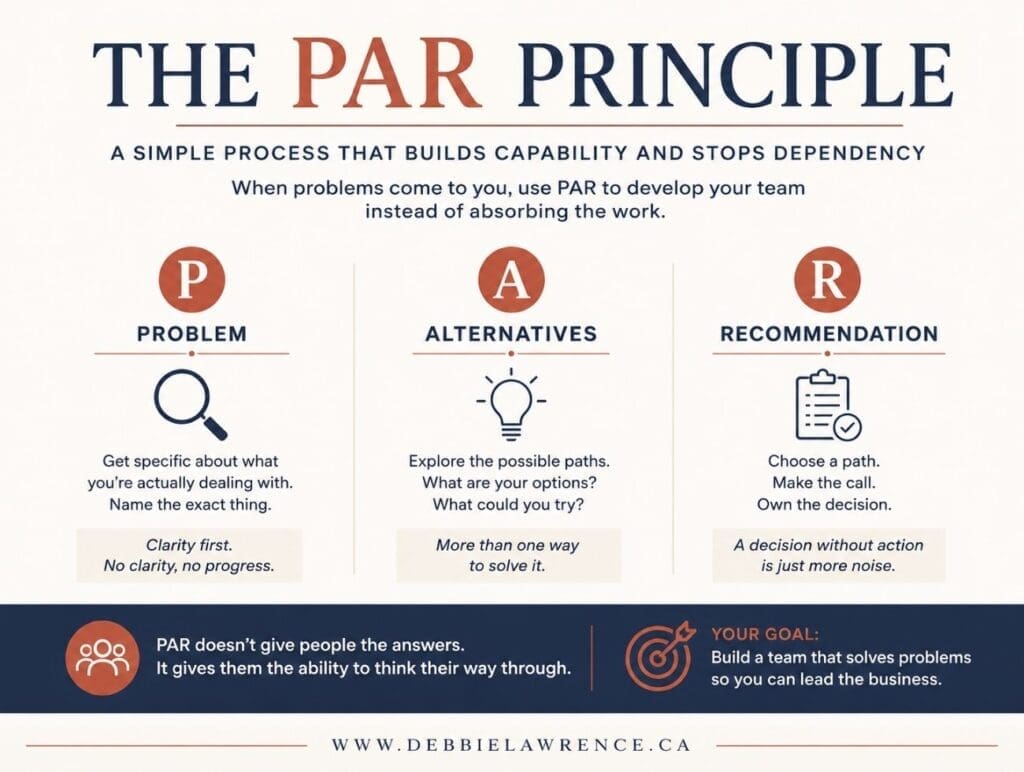
I call it the PAR Principle.
P: Problem. Before anything else, get specific about what you’re actually dealing with. Name the exact thing.
We focused on one piece: staffing the phone banks. In those days, connecting with constituents meant evening calls, seven to nine, when people were home but not yet watching the news. Twelve phones, trained volunteers, six weeks of nightly calls. Getting that right, and getting it going immediately, was non-negotiable.
“So that’s the problem,” I said. “How do we make sure every phone is staffed, every night, for the next six weeks?”
A: Alternate courses of action. “What are the possible ways we could solve this? All of them. And we always start with the one no one wants to say out loud: we could do nothing.”
He laughed. “That’s not really an option.”
“No,” I said. “But naming it makes us honest about the stakes. What else?”
He started to think. He could put a sign-up sheet on the wall and let people choose slots as they came in each day. He could ask upfront who wanted to work the phones, gather availability, and schedule them on a weekly basis. Or, and here his thinking sharpened, he could build standing teams. A Monday night team. A Tuesday night team. Each person committed to their night, trained, and consistent throughout the campaign.
We walked through each one. What are the upsides? What happens when something goes wrong?
The walk-in approach was flexible but unpredictable. Some nights you might have twelve phones and eight people. Some of those people might be untrained. The weekly scheduling was more organized but still reactive, constantly checking, constantly filling gaps, managing confusion when someone’s availability changed. The team approach had him leaning forward in his chair.
“If I build teams,” he said, “I’m not managing twelve slots every night. I’m managing relationships. I know who’s coming. They know their commitment.” He paused. “And I could build a backup list. People who want to help when someone can’t make their night.”
We were brainstorming now. He was thinking out loud, building on his own idea.
R: Recommendation. “Based on all of that,” I said, “what do you recommend?”
He looked at me like the answer was self-evident. “The team approach. With the backup list.”
“Then go build it.”
The whole conversation took maybe thirty minutes. But Evan walked out of that office a different person than the one who’d walked in. He wasn’t carrying my solution. He was carrying his own, and he was going to prove it was the right one.
What changes when they own it
Here’s what changes when someone owns the solution: they see it through.
When you hand someone your answer and it hits a snag, it comes back to you. “I tried that thing and it didn’t work.” Because it was your idea, they have no skin in it.
But when someone reasons through the options, weighs the tradeoffs, and puts a recommendation forward in their own words? They troubleshoot. They adapt. They figure it out, because it belongs to them.
Nine times out of ten, and in my experience it’s higher than that, their recommendation is a solid one. Sometimes you add a consideration they missed. Sometimes you adjust a detail together. But the thinking is theirs. The ownership is theirs.
And over time, something shifts.
The person who used to walk in and drop a problem on your desk starts walking in to give you a brief. “I wanted to keep you in the loop. We had an issue last week. I looked at a few options, went with this one, and it’s handled.”
When you hear that for the first time, you’ll know exactly what it means. And it is absolutely a moment worth celebrating.
What I do now
I still get asked for answers. That part hasn’t changed.
What’s changed is what I do when the question arrives.
I pause before responding. The pull to answer immediately feels like helpfulness, like competence. I’ve learned to let that moment pass.
I ask what they think, first. Every time. And when someone is really stuck, I ask a question that has never once failed to crack a conversation open: “If you knew the answer, what would it be?” I don’t know what it is about those words, but it is pure magic. More often than not, it does most of the work.
I use PAR when I can see someone hasn’t thought it through yet. Not as a formula to perform but as a conversation. We get specific about the problem. We name the options. We move toward a recommendation they can own.
I celebrate when someone solves it themselves. Quietly. “That’s exactly the kind of thinking I was hoping you’d bring to this. Great ownership of this and thanks for keeping me in the loop.”
There are times when someone walks in and says, “I’m genuinely stuck. I’ve got one possible path but I’m not sure I’m seeing clearly.” That’s when we roll up our sleeves together. PAR isn’t about withholding help. It’s about building the capacity to think, so that the next time, and the time after that, they need you a little less.
The relationship changes. You stop being the person who has all the answers and start being the person who helps people find their own. That’s a different job.
It’s a better one.
Your turn
This week, when someone brings you a problem, pause before you answer.
Ask: “Walk me through what you think we should do?”
Then wait.
You might be surprised how much thinking was already there, waiting for permission to show up.
Comment below and tell me: when did someone on your team solve a problem you almost solved for them? What shifted when they owned it?
I read and reply to every comment. And I love hearing from you.

You can also listen to this issue on The Compassionate Leader School podcast episode, which drops the same day on Apple Podcasts, Spotify, and all major platforms. Click here to explore all the episodes.
