



Are You Being Collaborative or Waiting for Permission to Lead?
Issue 13
By Debbie Lawrenc
Read Time: 8 minutes
Trish
Trish owns a retail operation. When she arrived for a coaching session a few weeks ago, I asked her what she wanted to talk about, and she didn’t hesitate.
“I’m so frustrated with my team.”
I asked her what was going on.
She’d been wanting to upgrade her point-of-sale system for a while. Her team had been using the current one for years, everyone was comfortable with it, and she’d anticipated some resistance to the change. So she did what she always did. She brought the team in. She wanted everyone to agree on whether they were even making the switch before a commitment was made.
They agreed. The upgrade made sense so the team was on board.
Then she went back to them for the next piece. Which features mattered most? What did they need the new system to do? She wanted their input before choosing a platform.
That’s where everything stalled. Different people wanted different things and a couple of staff hadn’t offered any input at all. She needed this to happen now, and it wasn’t moving.
“Do you know which platform YOU want?”
“Yes,” she said.
“So what’s keeping you from making the purchase?” I asked.
She paused. “Because I want it to be collaborative.”
That answer opened a longer conversation. I could see, as we talked, that Trish’s identity as a leader was built on this — being the collaborative leader, the one who brought people in, the one who made sure the team felt included and heard. I knew that challenging it directly would be tricky. What sounds like a value is always harder to examine than what sounds like a problem.
So we kept talking. And as the layers peeled back, something else came into view.
Trish was afraid. She hadn’t named it that way. She would have said she was frustrated, or that her team was dragging their heels, or that it wasn’t easy getting a group of people to agree on a list of needs. But underneath all of it, driving the original habit and shaping the identity that had grown up around it, was a genuine fear that was completely outside her awareness.
If she simply said, “Thank you for your input. I’ve made a decision, and we are moving forward,” the broken playbook she unconsciously subscribed to that was constantly running in the background would have told her some variation of this: your staff are going to label you as uncooperative and inconsiderate. Maybe even mean. As we dug into it further, what she came to see was that her biggest fear was that it would drive disconnection between herself and any team member who didn’t get what they wanted.
That fear was so familiar, so thoroughly hers, that she couldn’t see it.
I said, “Trish, who’s paying for this system?”
She said, “I am.”
“And the implementation? The training for your staff?”
“All me.”
“So the risk sits entirely on your shoulders.”
She was quiet.
“The input is worth getting,” I told her. “But the decision has been yours all along. You just haven’t claimed it yet.”
What Trish didn’t know yet
Trish thought she had a team problem. What she came to realize was that she had an issue with not using her earned authority.
She had collected buy-in, gathered input, and kept the conversation about the POS system open for weeks. None of that was wrong. What was wrong was the belief underneath it: that she needed all of that in order to earn the right to decide.
She didn’t. She was the owner. The authority came with the risk she was already carrying.

The pattern I see everywhere
I have coached women who lead for decades and this pattern shows up in every cohort, every industry, and every stage of a leader’s journey. A retail owner stalled on a software upgrade. A founder who hasn’t changed her pricing structure because she wants the team to feel consulted. A senior leader who routes every strategic decision through a group that doesn’t have the authority, or the depth of experience, to make it.
What they all share: they already know what they want to do. And they are not doing it.
The buy-in process happens for predictable reasons, and every one of them sounds like a virtue.
“I value collaboration.” Maybe she does. Genuinely. The broken playbook counted on that. It took something real known as collaborative leadership, which is a legitimate way to lead, and turned it into a shield. Now she uses collaboration when she needs it, and also when she’s afraid, and she can’t always tell which is which.
“I want my team to feel heard.” She does and that instinct is worth honouring. But there is a difference between creating real space for input on decisions that genuinely need it and running a consensus process on decisions that were already made, or should have been. One honours the team. The other uses them.
“If I just decide, they’ll feel dismissed.” This is the fear underneath the virtue. It’s also the one that does the most damage, because it’s the one the broken playbook built everything on. There was research into what was termed the double-bind dilemma that goes back to the 1970s. It concluded that women leaders engage in communal sharing principles like collaboration, shared responsibility, and consensus-based decision-making while men are seen as naturally employing authority-ranking principles without engaging in any of these communal behaviours. Across multiple studies researchers found that female bosses felt restricted by their own perceptions of how women should act and that these women leaders reported feeling like they couldn’t be as direct in their feedback or instruction giving due to fears of being perceived as rude or demanding. Sadly, not much changed over the decades that followed.
Women who lead, just like you, have been told, in countless ways and for a very long time, that using authority directly is a liability. The message doesn’t always come in words. Sometimes it comes as a social cost: the cold shoulder, the whispered conversation, the sense that something shifted in a relationship after you made a call that wasn’t popular. You don’t have to experience it directly to learn the rule. You just have to watch it happen to someone else.
So you build a process that protects you from it. You call it collaboration. You come to believe that it is collaborative and the belief protects the process from ever being examined.
That is not a character flaw. That is how the broken playbook works. It’s filled with rules that don’t feel like rules from the outside. They feel like values from the inside.
The test
Genuine collaboration and accountability distribution look identical from the outside. Both involve asking for input. Both produce meetings and conversations and feedback. The difference lives in one place: why you called the room.
Genuine collaboration is when you don’t know something the team knows, and you need that information to make a better decision. You come in without a conclusion and their input changes the outcome.
Accountability distribution happens when you already know what you want to do, or what needs to happen, and you’re running a process that lets you spread responsibility for the decision before you’ve fully claimed it. The input might be useful but you weren’t going to change course based on it.
Before you extend the next invitation, ask yourself one question.
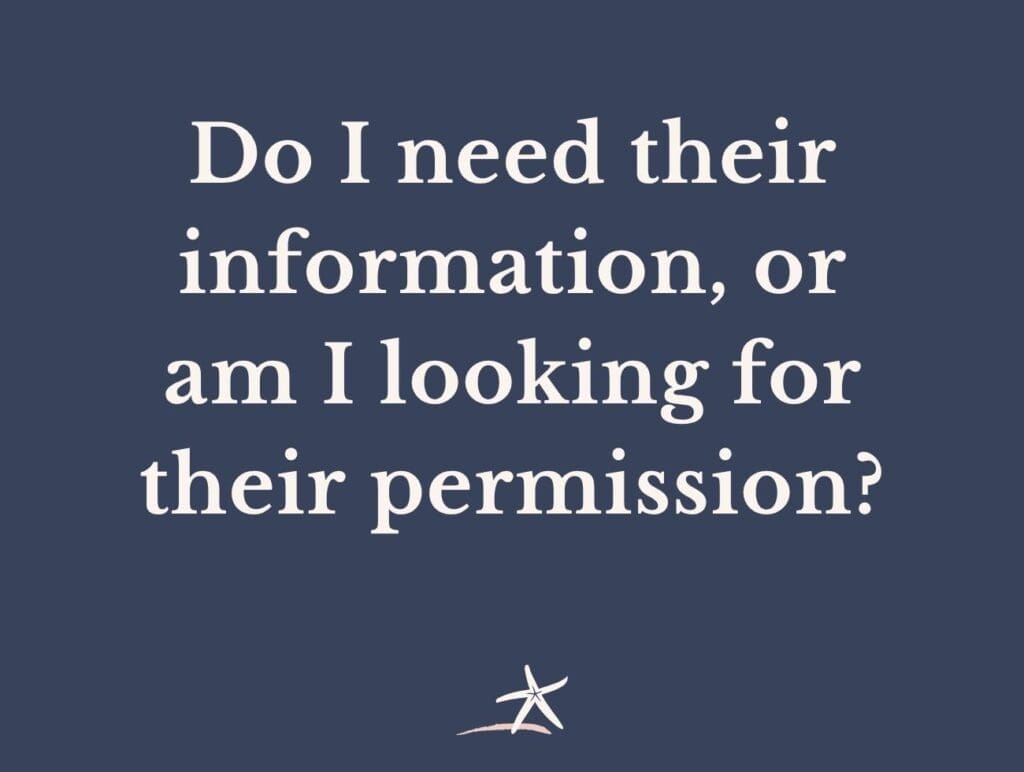
Do I need their information, or am I looking for their permission?
If you need their information such as specific knowledge they have that you don’t or experience with a system or a client or a process that lives with them, call the room. That’s what it is for.
If you need their permission, if what you are really waiting for is for everyone to agree so that you don’t have to be the one who decided alone, stop right now. Name it and own the call.
You may still want to involve the team after you’ve decided. Explaining your reasoning, honouring what you heard in the process, and giving people the chance to ask questions are all worth doing. But there is a difference between a leader who explains a decision and a leader who outsources one. The first is clarity. The second is a slow drain on everyone’s time, including yours.
What I do differently now
When a decision is sitting still and I can’t figure out why, I ask myself: is this stalled because I genuinely need more information, or because I haven’t been willing to own it?
The answer is apparent within about thirty seconds. And it is almost always the second one.
Here’s the other thing I’ve learned. When I make the call and communicate it clearly, the disconnection I was afraid of rarely comes. What comes, more often than not, is relief. The team had been waiting. They didn’t know what to do with the ambiguity, so they slowed down and hedged. Once the decision was made, they could finally move forward.
The fear that keeps the process going is almost never proportionate to what actually happens when you step through it.
I’m not saying there’s no friction. A decision made without full consensus can create some. But a decision unmade creates something worse: a team that stops trusting the leader to lead.
Trish sent her team a clear message the following week. Thanking them for their input, she announced that the features were chosen, the platform was selected and implementation was scheduled on a specific date. She told me later that two people on her team thanked her for finally making the call.
They’d been waiting too.
Your turn
Somewhere in your work right now, there is a decision you are treating as collaborative that may actually be yours to make.
It might look like a stalled project. An upgrade you keep consulting the team on. A structural change that has been in conversation for months. A call you keep saying you want alignment on before you move forward.
This week, ask the question: do I need their information, or have I been seeking their permission and calling it collaborative leadership?
If the answer is permission, make the decision. Communicate it clearly and with care. Let your team do what they are there to do.
You don’t have to announce that anything has changed. You just have to decide.
Comment below and tell me: what’s the decision you’ve been consulting your team on that might actually be yours to make?
I read and reply to every response. And I love hearing from you.

You can also listen to this issue on The Compassionate Leader School podcast episode, which drops the same day on Apple Podcasts, Spotify, and all major platforms. Click here to explore all the episodes.
