



I Had the Hard Conversation. Then I Let It Slide.
Issue #21
By Debbie Lawrence
Read Time: 9 minutes
The attendance report was due Friday. It was the following Tuesday.
I was standing at the printer composing the note in my head that I would leave on his desk (this was before the days of email). Not too sharp. Not too soft. The one that opens with “just following up!” and lets the exclamation mark do all the emotional labour.
Wayne had been teaching at the college for a couple of years and I inherited him when I became head of the newly formed business management faculty. He was good in a classroom. He was also the person I chased for everything like weekly attendance reports, course outlines, and grades. Any document with a due date attached to it found me asking for Wayne’s submission after the deadline had passed.
One late attendance report is not a crisis but 16 of them across a semester becomes a burden.
We had a routine, Wayne and I. He’d miss the deadline. I’d chase. He’d say he forgot and occasionally apologize. Sometimes the thing appeared. Sometimes I chased again. Once in a while, I had to make a third attempt before it landed on my desk. What I never did was say out loud how this keeps happening, and it needs to stop.
I did this dance for a full semester.
Over the holiday break I made myself a promise. I was not doing another four months of the dance so I booked a meeting before the start of the winter semester, sat down with him, and said it clearly, kindly, and directly. He heard me, agreed, and told me things would be different. I wanted to believe him and took what he said at face value.
The first three weeks were genuinely good. Everything arrived on time and I remember feeling a little smug about how well I’d handled it.
Then week four hit and the attendance report didn’t come in.
I said nothing directly to him.
Instead, I told myself it was one week in what had become a great run for Wayne. Bringing it up now would be petty after he’d made such an effort and I defaulted to my old thinking of hoping he would notice and self-correct.
He did not self-correct so the chase ensued. By week 7 we were solidly back to the old routine, and by week 10 it was worse than before, because I had just taught him the most useful thing he could possibly learn about me at that time which was I say things, and then nothing happens.
That pattern ran the rest of the semester. By the end of it I could hear myself in exchanges with him being clipped, tight and a little sarcastic in a way I’m not proud of. The resentment had been quietly compounding for months and it was leaking out sideways, at a man who had no idea he’d crossed a line, because I’d never once shown him where the line was.
That’s not the leader I wanted to be and that part was entirely mine.
So at the start of the next semester I scheduled a meeting with him again only this time I started somewhere different.
I revisited our conversation back in January where I told him the missed deadlines weren’t okay. Then I acknowledged his strong start and also how I’d said nothing after he slipped back into his old pattern, and how my silence had told him it was fine. I think I surprised him when I said that this was on me.
I also restated that the missed deadlines were not okay. I explained the standard, why it was in place, and exactly what would happen the first time it was missed.
Three weeks later, he missed a deadline and this time I did the thing I said I’d do.
What surprised me was that it never happened again.

The pattern revealed
I spent that whole first semester believing my problem was that I hadn’t had the conversation yet. Then once I finally had it at the beginning of the next semester, I thought the work was done. Turns out the conversation was the easy part. Consistently holding the line every day after was the heavier lift.
This is a familiar topic with my coaching clients. It almost always shows up as some version of my own story where the leader observes a team member not meeting a standard but she’s reluctant to take action. Here’s what tends to be underneath that.
“I don’t want to nag.” This is the one I hear most. Following up starts to feel like hovering, so she stays quiet to prove she’s not that kind of boss. Nagging is complaining that lacks clarity and consequences. “Why can’t you ever hit a deadline?” is nagging. ” Accountability is, “We agreed it would be done by Friday at 5. It’s Monday morning. Talk to me about what happened.” Nagging comes from powerlessness. Accountability comes from clarity and a prior agreement you’re now verifying.
“She promised she’d change.” Of course she did. Most people mean it in the moment. Behaviour doesn’t shift because someone made a promise in your office on a Tuesday. It shifts when there’s consistent follow through on the other side of it. The promise is nice but the follow-up is what does the work.
“I don’t want to be the bad guy.” When you don’t hold the line, the cost of one person being upset with you just gets distributed to everyone else. Your strong performers watch someone get away with less and quietly recalculate what’s worth their effort. The person who’s struggling reads your tolerance as approval and keeps repeating the same unhelpful behaviour. And you sit with a slow build of resentment toward someone who genuinely doesn’t know they’re doing anything wrong.
Every one of those reasons sounds decent from the inside. That’s what makes them so effective at keeping you stuck.
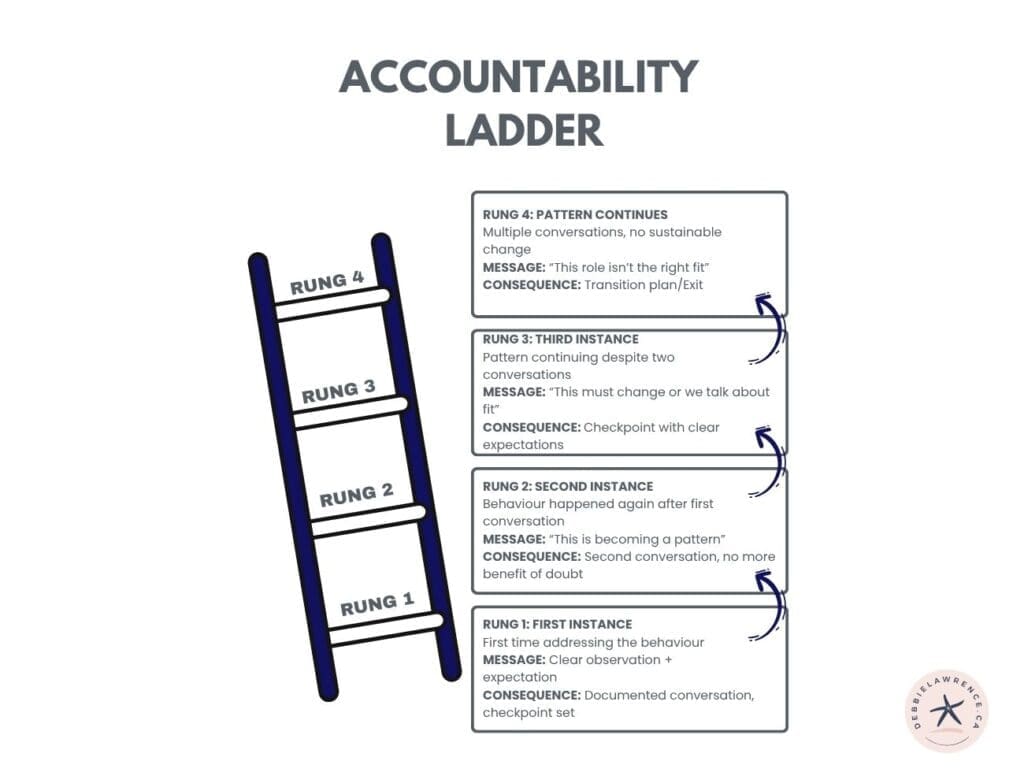
The accountability ladder
What I was missing back then was a way to respond proportionately. I only had two settings: say nothing, or have The Big Conversation. So I’d stay on the first setting for months, then jump to the second, then slide back to the first when it didn’t stick.
What I learned was how coaching for performance works better as a ladder. Each time the standard is missed, you move up one rung rather than stand on the bottom rung for months, having the same conversation on repeat or saying nothing at all.
Rung 1. First time. A clear observation and a clear expectation, and then you check that it landed.
“I noticed the attendance report came in two days late. Moving forward I need it by the agreed deadline, and if something’s going to get in the way, I need to know at least 24 hours ahead of time so we can make a plan accordingly. And it’s important that I communicate this clearly so I would appreciate it if you could share what you understand needs to happen based on our conversation today.”
That last sentence matters more than it looks. It’s the difference between telling someone and confirming they got it. Then you set a checkpoint and write the date down.
Rung 2. It happens again. You name the pattern out loud and get curious about the cause.
“We talked about deadlines on July 15th. The draft course outlines were due on Friday and I got them the following Tuesday instead. That’s twice in two weeks. Talk to me about what’s getting in the way.”
This is where most leaders go quiet, because it feels repetitive but repetition is the point. You’re establishing that your standards don’t have an expiry date.
Rung 3. Third time. Now it comes with a consequence attached and a date on it.
“We discussed this on July 15th and July 29th. The August 5th report was late too. I need to be clear here. This has to change, or we’ll be talking about whether this role is the right fit. I’m setting a checkpoint for September 1st. Between now and then I need every deadline met.”
Say the consequence out loud, and only if you’re actually willing to carry it out. Otherwise it’s not a consequence.
Rung 4. The pattern continues. You have the conversation you said you’d have.
“We’ve talked about this three times. I set a checkpoint for September 1st and two more deadlines were missed in that window. I’m not seeing sustainable change, and I don’t think this role is the right fit. Let’s talk about a transition.”
The rungs get more serious as you climb, which is the whole design. What keeps people stuck on Rung 1 forever is the hope that this time they’ll fix it on their own, so you never have to climb the ladder at all.
What I did differently
Having learned from that experience, I started putting the checkpoint in my calendar during the conversation, while the person was still sitting in front of me. I knew that if the follow-up date lived only in my head, it competed with everything else in my head, and it lost every time.
I also stopped treating the first slip as a fluke because the first slip is the whole thing. It’s the moment the person finds out what your words are worth, and believe me they will find out one way or the other. Saying “we talked about this on Tuesday, and it’s happening again” three days later is clear and direct. It’s also the kind of response that lends itself to modifying this kind of unhelpful behaviour.
Your turn
Think of one conversation you’ve already had, where the behaviour crept back and you decided to let it go.
Go back this week and have a conversation that starts with this one sentence: “We talked about this on [date]. It’s happening again. Talk to me about what’s going on.”
Remember, you’re not reopening it because you never closed it in the first place.
Comment below and tell me: what’s the agreement you let slide, and what did your silence end up teaching them? I want to know what you see once you name it.
I read and respond to every comment. And I love hearing from you.

P.S. Most of the leaders I work with don’t need help finding the words to say as much as they need help holding the line for the six weeks after the words are spoken. That’s a lot of what we do in 1:1 coaching and inside The Clarity Cohort. If you’ve had the conversation more than once and nothing’s moved, let’s talk.
P.S.S. You can also listen to this issue on The Compassionate Leader School podcast episode, which drops the same day on Apple Podcasts, Spotify, and all major platforms. Click here to explore all the episodes.
